Saturday, December 2, 2017

Neil Young Archives

The Neil Young Archives is now on-line, starting today [December 1, 2017]. 

“We developed this site, neilyoungarchives.com, to provide fans and music historians with unprecedented access to all of my music and to my entire archives in one convenient location. My team and I have spent years developing this site to make it both enjoyable and easy to use. The site allows me to share with the world the material I’ve spent a lifetime creating and collecting. I hope you enjoy it.”  Neil Young, December 1, 2017.

The NY Archives allows you to log on through your Facebook account.  Once you do so, you are presented with a picture of the front of a filing cabinet.  In big bold letters there is a “WELCOME MESSAGE FROM NEIL’.  After you click there, the man himself gives you a 10-minute tutorial video on how to navigate the archives.  He doesn’t walk you through every little detail – he leaves the exploration of things unexplained to you, the user.  I will show some of the features that I think are good.  To get to the main menu, you click on the “filing cabinet” in the upper left-hand corner, and then you can navigate accordingly.


Audio Setup.  NY has provided the master recordings of his music for you to hear.  If you have a screaming internet connection with blazing speed, this feature is for you.  But if you are a “disadvantaged user” like me, there is a toggle switch that lets you listen at 320 kbps.  For my ears, that’s good enough.


Find.  This is the search engine portion of the archive.  In this example, after I clicked on “FIND”, I typed in Cinnamon Girl.   The results include every album on which the song appears.


Info Card.  Once you click on one of the links presented by the FIND feature, you get an “Info Card” about the song.  Here’s where you find the who, what, where, and when this particular version of this song was recorded, and on which album it was released.  I clicked on the Everybody Knows This Is Nowhere link.  Click on the “play” button at the top of the Info Card, and it will playback that version of the song you chose.


Buy.  NY doesn’t do any of this for free.  If you want to buy the version of the song you’re listening to, click on “BUY” and it will take you to Amazon.


Video.  If there is any video connected to the song, a VIDEO button appears.  Not every song in the archive has this feature.  After you click VIDEO, a “VIDEO TAPE LOG” appears.  For those songs that have the video feature, there is at least one video related to the song.  Some songs have more than one related video.  In the case of Cinnamon Girl, there’s a 53-second promo video.


Lyrics.  This one is self-explanatory.

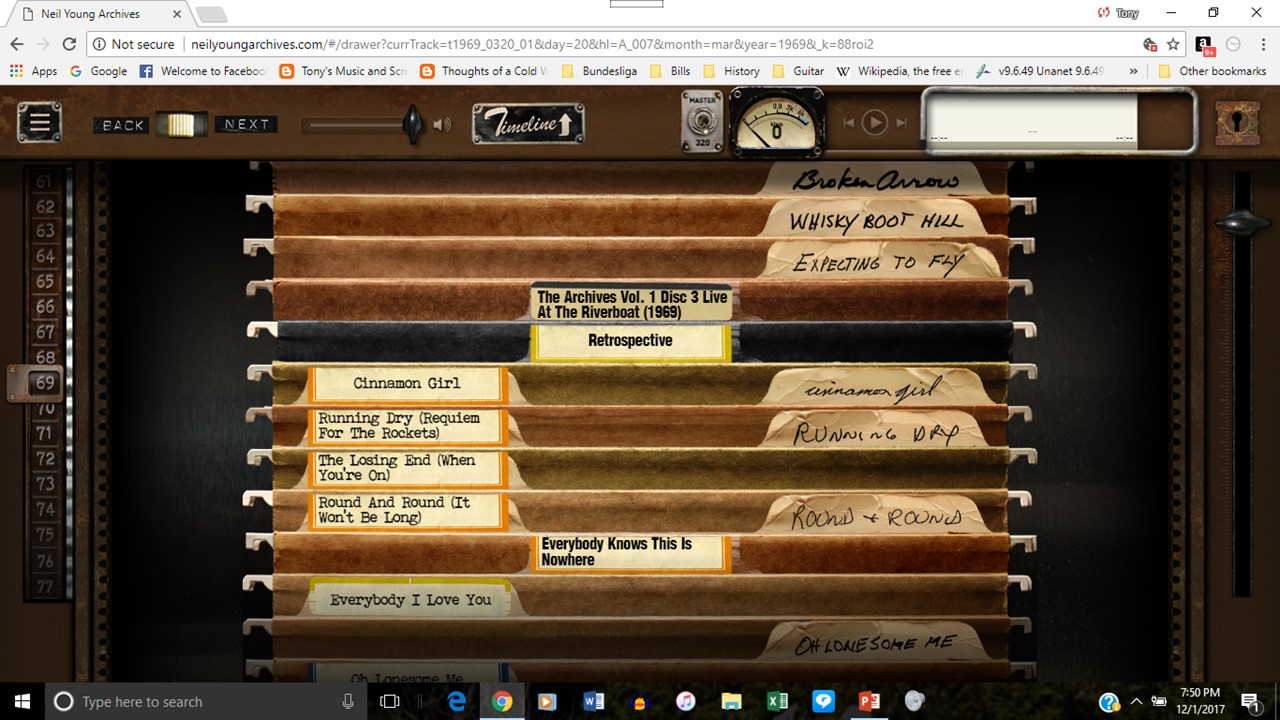
File Cabinet.  If you have a lot of time, the File Cabinet feature will let you browse.  When you click on the song title you’re interested in, the Info Card pops up.


Timeline.  Another feature I like is the TIMELINE feature.  From the song’s Info Card, there is a TIMELINE link in the bottom right-hand corner.  When you click on that link, you go to the TIMELINE page [shocking, I know].  Here you find almost everything NY released – from his first single with his group The Squires [The Sultan – 1963] to his latest album, The Visitor [also released today].  For Cinnamon Girl, there is a metadata arrow that points to a blue bubble.  Click on it and it’ll take you back to the Info Card. I noticed there are two other blue bubbles under Cinnamon Girl.  These are for the songs Running Dry [Requiem for the Rockets] and The Losing End [When You’re On].  In the little metadata bubble, there is a “VIEW” button.  Notice that when you get to the song’s Info Card, there is a date on the bottom of that card.  For these three songs, the date is March 20, 1969.  NY and Crazy Horse recorded these three songs on that day.  When you go back to the TIMELINE, notice there is a band that indicates what month you’re looking at.  Below the band are the individual songs and their respective recording dates.  Above that band, you see the albums on which those songs were released.


View All Tracks/Zoom Out.  This feature can be accessed via the link in the bottom right-hand corner of the timeline.  It’s a toggle switch – if it says VIEW ALL TRACKS you see both the track recording date and the album on which the track appears.  If you don’t want that much information, click ZOOM OUT.  The track information disappears, but you still see where each album has been released.  In the lower left-hand corner, there are toggle switches for “ORIGINAL RELEASES” and “ADDITIONAL RELEASES”.  The additional release feature indicates various compilation albums.  If you see an album you want to know more about, click on the album icon you want. 


Significant Dates.  In the ZOOM OUT mode, you’ll see there are icons that look like price tags.  These indicate significant dates in NY’s history.  The example I provided shows when Danny Whitten died in 1972.


Video.  Also included among the “significant dates” are little video icons with the Shakey Pictures logo.  Here, I clicked on NY performing Birds [from the then yet-to-be released After the Gold Rush] during a CSN&Y show at the Fillmore East.


The good news.  There is a ton of stuff in this archive, and NY promises there will be more to follow.  The entire archive is very easy to navigate through.  The quality of the streaming audio is probably as good as it gets.  Since my internet connection usually as slow as dogshit, I have to settle for 320 kbps.  But on those odd occasions when I actually have some extra bandwidth, the audio is very good.  For amateur music historians like me, having the ability to find out the journalistic questions about all the songs included [who, what, where, and when] is literally at your fingertips and is very convenient.  The songs are in chronological order, so as you go from song to song, you can see that as he recorded songs, they wouldn’t all go on the same collection.  For example, one can see the sessions for the albums that became American Stars ‘n’ Bars, Comes a Time, Rust Never Sleeps, and Hawks and Doves overlap.  All the songs are cross-referenced to albums they appear on [original album, compilation, or live].

The bad news.  This is where I get to nit-pick, because there isn’t anything horribly wrong here.

- Truth in advertising.  In his announcement of the archives on Facebook, NY says people will have “unprecedented access to all of my music”.  This is slightly deceptive as the music available for listening is music that has already been released.  If there is previously-unreleased music in this on-line archive, I haven’t found it.  It isn’t “all” here – yet.  To be fair, the archive is a work-in-progress.

- Not all the music is available for streaming.  If you want to find streaming audio of the music he created during the Geffen years, you won’t find it here.  This appears to be a Warner Brothers/Reprise-only archive.  NY’s music at Geffen has gotten a bad rep over the years, but I think that is somewhat exaggerated.  I am biased – I actually like some of that stuff, most especially the Trans era.  Songs that NY didn’t write [such as Bob Dylan’s All Along the Watchtower] aren’t streamed either.  Perhaps he couldn’t get the rights to do so from the publishers.


This is just my first exploration of NY’s Archive.  When he makes this a subscription service, I’ll probably join.  Enjoy!

Wednesday, November 22, 2017

Malcolm Young - RIP

Malcolm Young died at age 64 on November 18th.  Back in 2008, Mal had trouble remembering the songs that he wrote, so he had to re-learn them constantly while on tour to support Black Ice.  In 2014, the band announced Mal retired from the band for medical reasons.  As it turns out, the medical reason was that Mal was suffering from dementia.  Dementia is what ultimately took Malcolm Young from us.  Though expected, news of Malcolm Young’s death isn’t any less sad.  His death came a little less than a month after that of his brother George.  George made his first musical mark in the group The Easybeats.  Their big hit was Friday On My Mind.  After the Easybeats dissolved in 1969, George and his guitar-playing partner Harry Vanda went into music production.  When Mal and Angus formed AC/DC in 1973, George Young and Harry Vanda took them under their wing.  Mal and Angus learned much from their older brother, which included a healthy mistrust of the music business.  AC/DC was the Young family business.

When one thinks of AC/DC, the image of Angus Young in the schoolboy uniform immediately comes to mind.  Angus may have been the star, but AC/DC was Malcolm Young’s band.  Mal and his little brother Angus had a simple formula – rock in the traditions of Chuck Berry and Bo Diddley, and at high volume.  Mal wrote most of the riffs.  I think only Tony Iommi and Keith Richards are more prolific in creating enduring riffs.  Mark Evans, who played bass for AC/DC before they made it big, once wrote that Malcolm was “the driven one . . . the planner, the schemer, the ‘behind the scenes guy,’ ruthless and astute.”  The Youngs were stubborn.  AC/DC’s music had no room for keyboards or classical instruments.  The bagpipes would be as “exotic” as AC/DC would get [the Youngs and Bon Scott are Scots, after all…].  When you bought an AC/DC album, you knew what to expect – guitars, bass, and drums.  Angus Young was once quoted as saying “I'm sick to death of people saying we've made 11 albums that sounds exactly the same, In fact, we've made 12 albums that sound exactly the same.“  Not that there’s anything wrong with that.  We need some constants in our ever-changing universe, and happily AC/DC was one of them [Motörhead fits in the same category].  The Young brothers were small in stature, but their sound was huge.  Mal was the rhythm guitar player.  His guitar of choice was a Gretsch ’63 Jet Firebird, a three-pickup guitar with two of those pickups ripped out.  He used heavy-gauge strings [Gibson pure nickel roundwound strings, .012 to .056].  He might as well have used bass guitar strings…

During Malcolm Young’s lifetime, AC/DC released 175 songs.  I’m partial to those of the Bon Scott era.  The songs from this time are AC/DC at their most raw, most visceral.  Beginning with Highway to Hell [their last with Bon Scott], their recorded output became more polished [thanks to Mutt Lange].  The follow-up Back In Black was an homage to Bon Scott.  You know the rest of the story – you can count on one hand the number of albums that have sold more copies than Back In Black.  After that album, finding the nuggets on AC/DC albums became a harder task.  You can find them, but you have to sit through some extremely ordinary music to get to them, but that’s just one pinhead’s point of view.  That being said, each new AC/DC release gave the band a license to print money.  The formula worked.  Having Brendan O'Brien produce Black Ice [their last with Malcolm Young in 2008] and Rock or Bust [2014] was an inspired one.  The rough edges came back with these two records, but I think this may be the end for the band.  Whatever follows won’t be AC/DC.  Bassist Cliff Williams retired, drummer Phil Rudd is once again an outcast, and Brian Johnson is out [hearing problems].  With Mal having passed on, Angus is the last man standing [to steal a phrase from an upcoming biography].  With that, I give you ->

The Malcolm Young Memorial Playlist…

Highway to Hell [Highway to Hell, 1979] – when I hear this one, I must hear Hells Bells right after it.
Hells Bells [Back In Black, 1980]
Back In Black [Back In Black, 1980] – one of the best riffs ever.
Let’s Get It Up [For Those About to Rock, 1981] – the groove…
This House Is On Fire [Flick of the Switch, 1983] – more groove…
Thunderstruck [The Razor’s Edge, 1990]
Who Made Who [Who Made Who, 1986]
Sink the Pink [Fly on the Wall, 1985] – even more groove…
Jailbreak [’74 Jailbreak, 1984] – He made it out…with a bullet in his BACK!
Girls Got Rhythm [Highway to Hell, 1979]
Shot Down in Flames [Highway to Hell, 1979] – I said “baby, what’s the goin price?  She told me to go to Hell…”
Sin City [Powerage, 1978]
Rock ‘n’ Roll Damnation [Powerage, 1978]
Hell Ain’t a Bad Place to Be [Let There Be Rock, 1977]
Let There Be Rock [Let There Be Rock, 1977] – The white man had the schmaltz, the black man had the blues…
Down Payment Blues [Powerage, 1978]
Overdose [Let There Be Rock, 1977]
Riff Raff [Powerage, 1978]
It’s a Long Way to the Top [Dirty Deeds Done Dirt Cheap, 1976/1981] – bagpipes!
Kicked in the Teeth [Powerage, 1978]
Whole Lotta Rosie [Let There Be Rock, 1977] – 42-39-56
Have a Drink On Me [Back In Black, 1980] – Considering your last lead singer drank himself to death, a song like this might be in bad taste for other bands.  Not so for AC/DC.
For Those About to Rock [For Those About to Rock, 1981] – Fire!
What Do You Do For Money Honey [Back In Black, 1980]
Dirty Deeds Done Dirt Cheap [Dirty Deeds Done Dirt Cheap, 1976/1981]
If You Want Blood (You've Got It) [Highway to Hell, 1979]
Dog Eat Dog [Let There Be Rock, 1977]
Ballbreaker [Ballbreaker, 1995]
Rock 'N Roll Train [Black Ice, 2008]
War Machine [Black Ice, 2008]
T.N.T. [High Voltage, 1976]
Big Balls [Dirty Deeds Done Dirt Cheap, 1976/1981] – Who’s got big balls?
Night Prowler [Highway to Hell, 1979]
Rock and Roll Ain’t Noise Pollution [Back In Black, 1980]

Sorry…I just can’t add You Shook Me All Night Long.  It suffers the fate of being played on classic rock radio waaaaay too much.  A good song, but I don’t need to hear it ever again.


“As his brother, it is hard to express in words what he has meant to me during my life; the bond we had was unique and very special. He leaves behind an enormous legacy that will live on forever. Malcolm, job well done.” – Angus Young


Monday, October 16, 2017

Tom Petty - RIP

The past couple of years have been hard on musicians from my youth.  Of those who have shed their mortal coil and gone to the great gig in the sky, the passing of some was expected [Gregg Allman, BB King], and some unexpected [Prince, Chris Cornell, David Bowie].  Tom Petty’s death on October 2nd fits in the latter category.   One week he’s playing the last show of his band’s tour at the Hollywood Bowl, and the next week he drops dead of a heart attack.  He talked about this tour being the last long tour, and that he wanted to be around family more, especially his granddaughter.  When I heard the news, I did what I always do – complete immersion in the music.  I wanted to meditate for a good long time to rediscover the material that made Tom Petty a star, and I wanted to play catch up on the stuff that had come out since 1993.  That is a lot of music, and he and the Heartbreakers made it look so easy.  It’s not easy, but they made it look that way.  Such was his material that regardless if it’s the first time you’ve heard it or the hundredth time, you can’t help but think “anybody can do that”.  But you’d be wrong – creating good music is a craft that one has to work at for a long time.  And because Tom Petty had worked very hard on his craft, the music just flowed like it was always the soundtrack of your life.

I have three or four Tom Petty playlists on my iPod.  One playlist is the “no brainer” playlist.  It looks a lot like his Greatest Hits record for MCA, that covered everything Tom Petty and the Heartbreakers did between 1976 and 1993.  It includes a couple of tunes from the Travelling Wilburys.  Another playlist is from that first pre-Heartbreakers, pre-fame band, Mudcrutch.  The other two playlists divvy up tracks from Wildflowers, Echo, Highway Companion, The Last DJ, Mojo, and the last TP and the Heartbreakers album, Hypnotic Eye.  I’ve got some stray tracks that didn’t make any albums, and a couple from a soundtrack album called She’s the One.  Why so many playlists?  Simple – I don’t really like long playlists.  I group my music by moods, sometimes by sounds, sometimes chronologically.  It just depends…

Free Girl Now [Echo, 1999]
Swingin' [Echo, 1999]
The Wrong Thing To Do [Mudcrutch, 2008]
First Flash of Freedom [Mojo, 2010]
The Trip to Pirate's Cove [Mojo, 2010]
I Should Have Known It [Mojo, 2010]
Lover's Touch [Mojo, 2010]
Something Good Coming [Mojo, 2010]
Good Enough [Mojo, 2010]
Fault Lines [Hypnotic Eye, 2010]
Red River [Hypnotic Eye, 2010]
All You Can Carry [Hypnotic Eye, 2010]
Forgotten Man [Hypnotic Eye, 2010]
Shadow People [Hypnotic Eye, 2010]
Rhino Skin [Echo, 1999]
Can't Stop the Sun [The Last DJ, 2002]
Lover of the Bayou [Mudcrutch, 2008] – A great Roger McGuinn song from the Byrds’ Untitled.
Bootleg Flyer [Mudcrutch, 2008]
I Forgive It All [2, 2016]
Hungry No More [2, 2016]
Crystal River [Mudcrutch, 2008]

Got My Mind Made Up [Nobody’s Children, 2015] – there are two versions.  Bob Dylan has the other one…
Waiting For Tonight [Nobody’s Children, 2015] – The Bangles!
Wildflowers [Wildflowers, 1994]
You Don't Know How It Feels [Wildflowers, 1994]
You Wreck Me [Wildflowers, 1994]
Honey Bee [Wildflowers, 1994]
To Find a Friend [Wildflowers, 1994]
Crawling Back to You [Wildflowers, 1994]
Don’t Fade On Me [Wildflowers, 1994]
Cabin Down Below [Wildflowers, 1994]
Walls (No. 3) [She’s the One, 1996]
Angel Dream (No. 4) [She’s the One, 1996]
Rusty Cage with Johnny Cash [Unchained. 1996]
Room at the Top [Echo, 1999]
Saving Grace [Highway Companion, 2005]
Square One [Highway Companion, 2005]
Down South [Highway Companion, 2005]
Ankle Deep [Highway Companion, 2005]

Mary Jane's Last Dance [Greatest Hits, 1993]
Learning to Fly [Into the Great Wide Open, 1991]
A Face in the Crowd [Full Moon Fever, 1989]
I Won't Back Down [Full Moon Fever, 1989]
Runnin' Down a Dream [Full Moon Fever, 1989]
Tweeter and the Monkey Man [Traveling Wilburys Vol. 1, 1988]
Last Night [Traveling Wilburys Vol. 1, 1988]
Wilbury Twist [Traveling Wilburys Vol. 3, 1990]
Southern Accents [Southern Accents, 1985]
So You Want to Be a Rock 'n' Roll Star [Live] [Pack Up the Plantation, 1986]
Keeping Me Alive [Nobody’s Children, 2015]
You Got Lucky [Long After Dark, 1982]
The Waiting [Hard Promises, 1981]
A Woman in Love (It's Not Me) [Hard Promises, 1981]
Even the Losers [Damn the Torpedoes, 1979]
Here Comes My Girl [Damn the Torpedoes, 1979]
Refugee [Damn the Torpedoes, 1979]
Don't Do Me Like That [Damn the Torpedoes, 1979]
I Need to Know [You're Gonna Get It!, 1978]
You're Gonna Get It! [You're Gonna Get It!, 1978]
Listen to Her Heart [You're Gonna Get It!, 1978]
Breakdown [Tom Petty and the Heartbreakers, 1976]
American Girl [Tom Petty and the Heartbreakers, 1976]

Sorry – no Free Fallin’.  The chorus ruins it for me.  It’s bad enough Jeff Lynne ruined the drum sound, but then he had to sing, too!

“I’ve read that Echo is my ‘divorce album,’ but Wildflowers is the divorce album.  That’s me getting ready to leave. I don’t even know how conscious I was of it when I was writing it. I don’t go into this stuff with elaborate plans. But I’m positive that’s what Wildflowers is. It just took me getting up the guts to leave this huge empire that we had built, to walk out. My kids … I knew this was going to be devastating to the whole family.”

According to biographer Warren Zanes -“Time to Move On,” “Hard on Me,” “Only a Broken Heart,” “To Find a Friend,” “Don’t Fade on Me”—they were all snapshots in a dark family album. When the Pettys gathered at their beach house in Florida to listen to the finished record, as they always did, Adria Petty says she “knew the marriage was over.”

Wildflowers is a very good “singer-songwriter” album.  There’s a lot of good stuff to be heard here, hence so many songs from that album on my playlist.  For many, the title track is their favorite from this album.  For me, It’s Good To Be King.

Echo is the post-divorce, deep, dark depression album by a guy with a heroin problem.  Again from Zanes - “Counting on You,” “Free Girl Now,” “Room at the Top,” “Swingin’”—these were songs written by a man fumbling for his keys in the darkness of unmanageable loss. If Petty and Mike Campbell have a hard time listening to the record, it’s likely because they’re seeing that man. And another: Howie Epstein.  Howie Epstein also had a heroin problem, but his was much worse, and heroin killed him.  Tom Petty cleaned up after he began the relationship with the woman who would be Mrs. Tom Petty #2, but Echo is the sound of a songwriter who is really pissed.  There’s heartache, melancholy, regret, and anger.  And look closely at the album cover – somebody is missing.  It was Howie Epstein.  No doubt the sight of their bass player wasting away before them cast a pall over the proceedings as they recorded Echo.  Despite all the problems, Echo is still a good listen.  Regardless of what TP thought at the time, I think Echo is TP’s Blood on the Tracks – it’s that good.  My favorite from Echo is Swingin’.  Rhino Skin is TP’s commentary on the survival techniques needed in the world.  It included the thick, tough skin of a rhino, with a dose of elephant balls thrown in.  Rhino Skin is a moody piece, but I really like it.  For all of the work he’s done with the Heartbreakers, currently my favorite stuff is also his most recent.  Mojo [2010] and Hypnotic Eye [2014] were the last two albums he did with the Heartbreakers. 

Before the Heartbreakers, there was a band from Gainesville, Florida called Mudcrutch.  They included TP, fellow Heartbreakers Mike Campbell and Benmont Tench, Tom Leadon [brother of Eagle/Flying Burrito Brother Bernie Leadon], and drummer Randall Marsh. They moved to Los Angeles around 1974, got a record deal, but then broke up before they could make their first album.  In 2008, TP got the band back together.  I think only he knows why he did it, but they finally recorded that debut album [Mudcrutch, 2008].  Mudcrutch was the sum of a lot of things - Laurel Canyon folk-rock, psychedelic-infused bluegrass, scrappy boogie-woogie, the country rock of the Flying Burrito Brothers and the swampiness of Clarence White-era Byrds, and extended excursions into Allman Brothers territory.  Mudcrutch screamed “roots”.  The album was recorded in the Heartbreakers’ rehearsal spaces, live on the floor.  Having captured that rootsy vibe in Mudcrutch, Petty, Campbell and Tench carried that over to the next Heartbreakers album, Mojo [2010]. 

Many critics have labelled Mojo a “blues album”, but this album is more than that.  The one thing Tom Petty wanted to do with Mojo was to give Mike Campbell’s guitar another “voice”.

“I really wanted to get Mike up to the front.  He’s such an incredible guitarist.  He also plays with a lot of taste.  He edits himself back a lot of the time.  And I told him “this time I really want you right up front. Let’s look at this like it’s a John Mayall record or a Jeff Beck record where the guitar is right up in the front.  You’re gonna be the other voice on the record.”

Mike got a 1959 Les Paul…and all hell broke loose.

Normally, Mike Campbell is a guitarist in the George Harrison mold – he plays whatever the song requires and doesn’t overstay his welcome.  But on Mojo, Tom Petty uncaged a guitar god beast.  Campbell and Petty do a great imitation of Duane Allman and Dickey Betts, playing harmony guitar parts in First Flash of Freedom.  Campbell throws down the Led Zeppelin “hammer of the gods” with I Should Have Known It, and he summons the ghost of John Lennon’s I Want You [She’s So Heavy] on the album’s final cut, Good Enough.  Not content with just “blues rock”, there’s real honest-to-God blues with U.S. 41 and Lover’s Touch, there’s what I like to call “music noir” [like 1940s film noir, only musical] with The Trip to Pirate’s Cove and Something Good Coming.  The band even throws in a little white-boy reggae with Don’t Pull Me Over [full disclosure – I don’t like this one, but I mention it to highlight this album’s musical diversity].  Benmont Tench is his usual, superb self, providing the right colors with acoustic piano, Hammond C-3 organ, and Wurlitzer piano.

The Heartbreakers’ next [and so far, last] album, Hypnotic Eye [2014], returned to shorter songs. 
When asked about the direction of Hypnotic Eye“As far as being a rock and roll record, you know where the first things we caught were some blues, we got three or four blues that came out very well.  I didn’t feel that that was the road to go down.  I felt like we’d been down that road, and though they came out really well, the next batch of songs tended to be different and when we recorded those suddenly we’re in rock-and-roll world and it’s going really well and I think that kind of dictated – this is all very subliminal – I mean, do I sit down and think about, you know, what direction I’m going?  I’m going with what’s working…

I really wanted a groove more than anything…you know, I just wanted the bass and drums to really groove.  I want the groove to be good on everything, and that’s missing from a lot of people that still try to do the rock-and-roll.  The rhythm section is so important, you know, it must be, it must create almost a trance, you know, between the bass drums and the rhythm instruments.  And that’s easy to say and hard to do – it’s not so easy but I guess our opinion is if we’re gonna do this as old men, then we should probably bring some level of sophistication to the table like we’ve gotten better at this and there’s actually a reason for us to do it…

Campbell’s guitar sound is razor sharp, and he plays his share of face-melting solos.  But it’s bassist Ron Blair who stands out.  On first listen to the groove-fest that is Fault Lines, I wondered when Ron Blair turned into Jack Bruce.  Not that Blair’s playing is overly busy, but his bass sound is huge.  I’ve never heard the bass so prominent in the mix on a Heartbreakers album.  Check out Fault Lines, Red River, and Forgotten Man and you can hear for yourself the bass’s newfound prominence on a Heartbreakers record.  Ron Blair and drummer Steve Ferrone are as solid a rhythm section as they come.  For each song, they get right in the pocket [Duck Dunn and Al Jackson, Jr would be proud].  They never make a misstep.  There is some blues on Burnt Out Town [the piano of Benmont Tench is especially impressive], and the Heartbreakers throw us a curveball with the jazzy [in a good way] Full Grown Boy.

Tom Petty is gone now, but he left us a lot of good stuff to listen to.  Rest in peace.


Saturday, September 9, 2017

Gregg Allman - Southern Blood

In my feeble mind, he had nothing to prove.  Being a part of the Rock and Roll Hall of Fame meant a lot to him.  His place in music history, and his legacy as part of the Allman Brothers Band is secure.  I have the feeling that as Gregg Allman, solo artist, he must have thought he still had something to prove, if not to himself, then to his fans every night on the concert stage.  He need not have worried on that score.  His fans were with him regardless of whether he was in a big band started by his big brother Duane or in his own band.

When Warren Haynes and Derek Trucks announced that 2014 would be their last year as part of the Allman Brothers Band, the proverbial writing was on the wall.  Butch Trucks didn't want to read that writing, and he wasn't shy about saying as much.  If Jaimoe had any opinions about the Allman Brothers Band finally calling it a day, I never heard him express any feelings publicly one way or the other.  But it was Brother Gregg who made it official.  Publicly, he expressed the need to concentrate on his own career.  What we in the listening public didn't know at that time was that Gregg Allman was slowly dying.

The liver cancer that he had prior to his liver transplant in 2010 had returned in 2012, and this time it spread to one of his lungs.  Rather than go through further cancer treatment (as a spouse of a cancer survivor, I know that chemo and radiation therapy are tough), he accepted his time on Earth was short.  He wanted to be at the top of his game until he could no longer perform.  His feeling was that cancer treatment would affect his voice, a situation he thought unacceptable.  It was with that same determination to give all to his fans that he decided to make one final album, a gift for his fans and a chance to say goodbye and thank you to us in his own way.  That album, Southern Blood, dropped today, three and a half months after he breathed his last in late May.

Until now Gregg Allman's last musical statement was 2011’s Low Country Blues.  That record, made with T-Bone Burnett, contained covers of old blues songs and one original song he wrote with Warren Haynes (Just Another Rider).  I think Low Country Blues is a fine album.  But it bugged Gregg that he didn't record it with his own band.  That would change with Southern Blood.  When he decided to make this album, it was going to be with his own road band instead of studio musicians, and he was going to do it at FAME Studios in Muscle Shoals, Alabama.  This is the same studio where his brother Duane made his first musical mark when he recorded Hey Jude with Wilson Pickett in 1968.  Duane and Gregg’s band Hourglass recorded their BB King Medley here [it’s on the Duane Allman Anthology].  Gregg's own musical circle would indeed remain unbroken.

Like Low Country Blues before it, Southern Blood is filled with covers and one final original song.  Gregg wanted to tell the story of where he's been, and where he was going.  The songs he chose to tell that story sound like they were written especially for him, but of course they weren't - they just fit that well.  Gregg's song choices were impeccable, and as there are several surprises as to the songs themselves and who wrote them, he demonstrated he still had a few musical tricks up his sleeve.  While the content on Southern Blood is mostly covers like Low Country Blues, the production sounds like 1997’s Searching for Simplicity, while the feel is like Laid Back, Gregg’s first solo album.  Like that first album, there are female choir voices, a steel guitar here and there, and the recording itself has a very warm feeling to it.  According to producer Don Was, the songs were recorded mostly live.  Gregg had been playing with this group of musicians for years, and they were tight.  This album demonstrates how tight they were.

The songs:
My Only True Friend – The only Gregg Allman original on the album, this would be the last of his own songs that he would record.  Written with guitarist Scott Sharrard, this is Gregg Allman’s ode to life on the road.  Sharrard said he was staying at Allman’s home and working on songs a few years ago when he “had a vivid dream where Gregg was talking to Duane.” He remembered the words and started working on a song he envisioned “as a conversation across the universe between Duane and Gregg.”  This song speaks to Gregg’s journey, that he was nearing the end of his life, and that he wanted people to remember him long after he's gone.  A humble and sensitive man, Gregg Allman underestimated his own importance to the fans who loved him.  He need not have worried that he would be forgotten.

Once I Was – One of Gregg Allman’s favorite songwriters was Tim Buckley.  He used to play this song for an audience of one – Scott Sharrard.  When it came time to make the record, Sharrard convinced Don Was of the need to put this one down.  Always thought of as a rhythm & blues purist, one forgets that Gregg had a folkie side, the product of his association with Jackson Browne.  This song is the first surprise of several on Southern Blood.

Going Going Gone – A Bob Dylan original that first appeared on the Planet Waves album he did with The Band in 1974, the original context of the title involved Dylan’s impending split with his first wife Sara.  The circumstances of Gregg’s recording of this song make these dark lyrics even more dark:

I've just reached a place
Where the willow don't bend
There's not much more to be said
It's the top of the end
I'm going
I'm going
I'm gone

I'm closin' the book
On the pages and the text
And I don't really care
What happens next
I'm just going
I'm going
I'm gone

I been hangin' on threads
I been playin' it straight
Now, I've just got to cut loose
Before it gets late
So I'm going
I'm going
I'm gone

Black Muddy River – From Jerry Garcia and Robert Hunter, this slow ballad first appeared on the Grateful Dead’s In The Dark album [1987].  Gregg was never a Deadhead [that was Dickey Betts’ thing], so this song is a bit of surprise.  In Gregg’s hands, this turns into a full-blown country song, complete with steel guitars and [for the first time] mandolins.

I Love The Life I Live – I forget with whom he did the interview [it might have been The Big Interview with Dan Rather], Gregg said that he and his brother Duane always listened to the blues greats on Nashville’s WLAC, that they especially liked Muddy Waters, Lightning Hopkins, and that they owned everything Howlin’ Wolf ever cut.  It’s no surprise that Gregg would include something from Muddy Waters on Southern Blood.  Gregg did Muddy’s I Can’t Be Satisfied on Low Country Blues.  Here’s another Muddy Waters song which I like much more than the original.  Gregg’s “unreconstructed Southern masculinity” oozes from every note he sings.  You can almost see the swagger in his walk when you hear this.

Willin – Brother Gregg finally does something from Little Feat.  It first appeared on 1972’s Sailin’ Shoes, this is an ode to living the life of a trucker, with bad weed and cheap wine.

Blind Bats And Swamp Rats – This funky [yes. you read that correctly] song is as fun as it is unexpected.  The song title was familiar, but I couldn’t remember where I heard it before.  Then it came to me – Johnny Jenkins, Ton-Ton Macoute! – the Duane Allman solo album that got away.  After Dickey Betts left the Allman Brothers Band, the Brothers had started to play Dr. John’s I Walk on Gilded Splinters from the same album [Duane played on it].   Gilded Splinters worked extremely well for the Brothers, and Brother Gregg does an equally fine job with Blind Bats and Swamp Rats.  This is my favorite from Southern Blood.

Out Of Left Field – This is a Percy Sledge song written by Dan Penn and Spooner Oldham.  Gregg liked Percy Sledge.  He once recorded a demo of When a Man Loves a Woman [which can be found on One More Try: An Anthology].  Given these lyrics, this song tells me he’s singing about his wife Shannon.  After his previous marriage ended he publicly mused that he probably wouldn’t marry again.  But as the song says, “fate stumbled in…”

When least expected
Fate stumbles in
Bringing light to the darkness
Oh, what a friend
I needed someone to call my own
Suddenly, out left field
Out left field, out left field
Love came along, ooh

Love Like Kerosene – I first heard this one on Gregg Allman Live: Back To Macon, GA.  Scott Sharrard wrote this one.  Gregg and the band give a very spirited performance.

Song For Adam – Gregg Allman’s history with Jackson Browne is well-documented, so I won’t rehash it here.  Browne wrote this song in memory of a friend who died from an apparent suicide.  But it reminded Gregg of someone else who died young – his brother Duane.  Gregg made a demo of this song in 1974.  That demo can also be found on One More Try: An Anthology.  He never put the song on an album until now.  According to producer Don Was, “once Duane passed away, I think it really reminded him of his brother. He’d always wanted to record it.”  If you didn’t know the story behind the song, one could easily think it was about Duane. 

Well, I still remember laughing
With our backs against the wall
So free of fear, we never thought
That one of us might fall

Given everything I’ve read about the early days of the Allman Brothers Band, this describes Duane and Gregg to a T.  Those were the good times, then came the bad.  The original lyric went like this:

Though Adam was a friend of mine, I did not know him long
And when I stood myself beside him, I never thought I was as strong
Still it seems he stopped his singing in the middle of his song
Well I'm not the one to say I know, but I'm hoping he was wrong

Gregg changed the words very subtly, but when he did the meaning changed and you know that he’s singing about Duane:

And when I stood myself behind, I never felt so strong…

Here’s the gut punch – when he sang this line, he couldn’t do the line after it.  It was too emotional for him, and he choked up. If you’re listening on headphones, you can hear his voice crack:

Still it seems he stopped his singing in the middle of his song…

Duane Allman never finished his metaphorical song.  Don Was is a pretty good producer, and when he heard Gregg stop suddenly in mid-song, he must have known he was onto something cosmic and left it that way.  Gregg heard this mix of the song the night before he went to sleep for the final time.  He liked what he heard and told Don Was to leave it the way he heard it.

David Bowie did it with Blackstar, and Warren Zevon did it with The Wind.  Leonard Cohen did it with So You Want It Darker.  As each man found out he was dying, each decided to make a final statement to say “goodbye” on their own terms.  They pulled it off rather well.  I believe Gregg did what he set out to do in making Southern Blood.  This album is simply stunning.


Monday, September 4, 2017

Walter Becker - RIP

Walter Becker died on Sunday.  He was 67.  If you don’t know who he is, stop reading now.

Becker’s partner in Steely Dan [Donald Fagen] wrote this about him today:  Walter had a very rough childhood - I’ll spare you the details. Luckily, he was smart as a whip, an excellent guitarist and a great songwriter. He was cynical about human nature, including his own, and hysterically funny. Like a lot of kids from fractured families, he had the knack of creative mimicry, reading people’s hidden psychology and transforming what he saw into bubbly, incisive art. We liked a lot of the same things: jazz (from the twenties through the mid-sixties), W.C. Fields, the Marx Brothers, science fiction, Nabokov, Kurt Vonnegut, Thomas Berger, and Robert Altman films come to mind. Also soul music and Chicago blues…

Walter Becker started out as a guitar player, but when Steely Dan formed, he switched to bass.  When you have two guitarists with the caliber of Denny Dias and Skunk Baxter, your guitar services become somewhat redundant, hence the switch to bass.  Steely Dan stopped touring after Pretzel Logic and became a studio concern.  The composition of Steely Dan varied from album to album.  It even varied from song to song.  If Becker needed to play guitar, he’d play it.  If he needed to play bass, he’d play it, though that became a lesser need once Becker and Fagen met Chuck Rainey.  What was Walter Becker’s role in Steely Dan?  Did he write the music, or did he write the words?  In an interview I read from nine years ago, Walter Becker was asked about the division of labor between himself and Donald Fagen:

Can you give a nutshell breakdown of the division of labor in Steely Dan? It’s hard for an outsider to know who’s responsible for what.
Yeah, I think that with most partnerships that run for a certain amount of time—and ours has run for a pretty long time—the division of labor is very ad hoc. So whatever needs to be done, sometimes I’ve got something to start with, sometimes Donald’s got something to start with. Sometimes we really work very closely, collaboratively on every little silly millimeter on the writing of the song and certainly of the records, and sometimes less so. And so over the course of the partnership, I think we’ve done all sorts of different things different ways, and probably that still is changing in a way, because if I can speculate on Donald’s behalf, I think there is a level of perfection, polish, sophistication, and abundance of detail and structural stuff that he wants to hear in his music that I sort of ran out of patience to do. My attention span is not that good anymore, and I sort of believe—and maybe the lyrics somewhere say this—that the perfect is the enemy of the good.

Steely Dan’s music was different.  While many a group from the 1970s went for high volume and was for the most part in 4/4 time, Steely Dan took the jazz route.  In 1993, Walter Becker said “we thought superimposing jazz harmonies on pop songs was subversive.”  Fagen and Becker are somewhat like Tom Waits in the themes they write about.  They look at humanity’s dark side, and sang anything but love songs.  Kid Charlemagne was based on LSD chemist Owsley Stanley, Cousin Dupree is somewhat incestuous [the dude loves his cousin], Rikki Don’t Lose the Number and Everything You Did are about infidelity, Everyone’s Gone to the Movies is an ode to pornography, Hey Nineteen addresses cradle-robbing, and so on.  It’s sex, drugs and jazz for these guys.

Why would a band name themselves after a dildo from a William Burroughs novel?  I’m not a big Steely Dan fan – I won’t pretend that I was/am.  .  She Who Must Be Obeyed especially doesn’t like them.  I can take Donald Fagen’s vocals in small doses only.  But [and there is always a ‘but’], I like Aja, a lot [The Royal Scam is a close second].  A friend from the old Ohio neighborhood, whose parents didn’t think much of public school education [and these days with mandatory testing, teaching to the test and federal funding that is dependent on test scores, can you blame them?], went to prep school in Connecticut.  When he returned for summer break, he introduced me to Steely Dan.  More specifically, he introduced me to Aja.  It’s one of those albums [like Pink Floyd’s Dark Side of the Moon] that you can ‘test drive’ a stereo you might want to buy.  It sounded so good you could play it on a shitty portable eight-track player [how’s THAT for dating one’s self?] and it would sound ok.  That came in very handy, for when I moved to Colorado in July 1978, all I had to listen to was a few eight-track tapes [one of which was Aja] and that shitty portable eight-track player. 

Until we finally moved into our little house on the prairie in March 1979, that’s all I had.  I still like Aja a lot.  After Aja came the song for a film called FM.  The song – FM [No Static At All] – that I thought was very cool [I still do].  Walter Becker didn’t play much lead guitar because he chose not to.  He and Donald Fagen were perfectionists, almost to a fault.  They hired the best players of any instrument in the business, and such was Becker and Fagen’s reputation for being stern taskmasters that these seasoned studio pros craved their approval.  They didn’t always get it.  Walter Becker was the EF Hutton of guitar players.  When he played, people listened. He played lead guitar on FM – I noticed.  It wasn’t until years later that I found out that FM was an outtake from Aja.  No wonder I liked it…  I eagerly awaited their follow-up, and it came in 1980 with Gaucho.  I heard Hey Nineteen on the radio, and I absolutely hated it [and still do to this day].  Gaucho was for Steely Dan what The Long Run was for The Eagles – it was boring, it took too long to make, and it was the album that killed the group [Third World Man is ok].  And like The Long Run, Gaucho killed my interest in Steely Dan.  It also killed Donald Fagen’s and Walter Becker’s interest in each other, so it’s comforting to know I’m not the only one who felt that way about that album.

Awhile back a Facebook friend of mine asked me what I thought about Steely Dan.  My answer was dismissive – “I liked them when I was a kid, then I grew up.”  But I’ve been doing a re-assessment over the last year.  Over time I grew to realize these guys were as crabby as I am.  And in this age where all music sounds the same, and everything is Unicorns and rainbows [cue the “millennial whoops” now], “different” from two old crabby, grouchy guys who write their own stuff, and who play real instruments with real musicians is just fine with me.

There isn’t much to add here.  In announcing his death, Walter Becker’s website simply read the following:

w a l t e r   b e c k e r              f e b .   2 0   1 9 5 0   —  s e p t .   0 3   2 0 1 7. 

I’ll keep it equally as simple – RIP Walter Becker.

Songs for the iPod:
Do It Again [Can't Buy a Thrill, 1972]
Showbiz Kids [Countdown to Ecstasy, 1973]
Rikki Don't Lose That Number [Pretzel Logic, 1974]
Pretzel Logic [Pretzel Logic, 1974]
With a Gun [Pretzel Logic, 1974]
Charlie Freak [Pretzel Logic, 1974]
Black Friday [Katy Lied, 1975]
Doctor Wu [Katy Lied, 1975]
Kid Charlemagne [The Royal Scam, 1976]
The Caves of Altamira [The Royal Scam, 1976]
Don't Take Me Alive [The Royal Scam, 1976]
Sign in Stranger [The Royal Scam, 1976]
Haitian Divorce [The Royal Scam, 1976]
The Royal Scam [The Royal Scam, 1976]
Deacon Blues [Aja, 1977]
Aja [Aja, 1977]
Peg [Aja, 1977]
Josie [Aja, 1977]
Black Cow [Aja, 1977]
Home at Last [Aja, 1977]
FM [No Static At All] [FM original soundtrack, 1978]
Down in the Bottom [Walter Becker - 11 Tracks of Whack, 1994]
Junkie Girl [Walter Becker - 11 Tracks of Whack, 1994]
Cousin Dupree [Two Against Nature, 2000]
Bob Is Not Your Uncle Anymore [Walter Becker - Circus Money, 2008]
Circus Money [Walter Becker - Circus Money, 2008]
Lucky Henry [Walter Becker - 11 Tracks of Whack, 1994]
Janie Runaway [Two Against Nature, 2000]
Third World Man [Gaucho, 1980]


Friday, August 25, 2017

Hitman's Bodyguard - a short review

After another TDY and yet another mind-numbing test flight of Global Hawk with a new sensor [and the buffoonery that went with it], some much-needed comic relief was in order.  We saw Atomic Blonde last week [I highly recommend it - she fights better than James Bond], so we had to see something else.  Tom already saw Wonder Woman [his two-word review – “it rocks!”], and I’m still trying to talk She Who Must Be Obeyed into going to see Dark Tower.  Most of what was available for our viewing pleasure is horse squeeze [The Big Sick?  It’s a chick flick.  Annabelle: Creation?  It’s a sequel.  The Emoji Movie?  Please…Dunkirk?  Seen it.].  But one thing caught my eye – Hitman’s Bodyguard.  It has Samuel L. Jackson and Ryan Reynolds.  What could go wrong?  The answer is…nothing!

Since Pulp Fiction, you pretty much know what you’re going to get with Samuel L. Jackson, except when he’s asking “what’s in YOUR wallet?” Ever since then, it has become a drinking game for some – how many times does he say “motherfucker” in a movie.  He’s made it his own artform – obscenity is his true medium.  There’s a video collage of him on YouTube called Every Samuel L. Jackson "Motherf*cker"...Ever [here’s the link - https://www.youtube.com/watch?v=c0LBi1MHoaU].  I just got back to the hotel after watching Hitman’s Bodyguard - the clip needs to be updated.  Ryan Reynolds hadn’t really achieved true stardom until Deadpool.  In Hitman’s Bodyguard he’s the same character as Deadpool, except without the costume.

Rather than give the story away, here’s my Joe Bob Briggs review of the movie:

45 dead bodies [that’s where I lost count];
8 explosions [or was it nine?];
22 “motherfuckers” [17 from SLJ, 3 from Salma Hayek, 5 from Ryan Reynolds];
Zero naked breasts;
Two gallons of blood:
Nail-gun Fu;
Chain Fu;
Pen-through-the-hand Fu;
One ass-kicking female Interpol agent [Elodie Yung];
Three lessons on romance from Samuel L. Jackson;
One scene of Salma Hayek’s ass in a tight pair of jeans;
Gary Oldman as a homicidal Belarusian president on trial for crimes against humanity;
A twenty-minute chase scene in Amsterdam including cars, trucks, motorcycles, and boats;


I loved the movie.  Everything you expect from Samuel L. Jackson and Ryan Reynolds, and more.  This movie is laugh-out-loud, blow Pepsi through your nose funny.