Tuesday, April 13, 2010

Paperback Writer/Rain

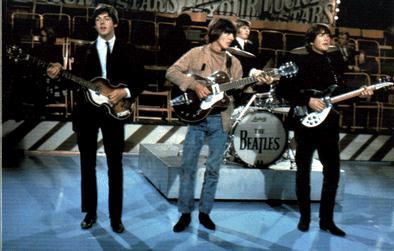
On this day in Beatles history [April 13, 1966], the Beatles began recording their eleventh single and its B-side, Paperback Writer and Rain. Though recorded during the sessions for Revolver, the songs appeared separately from the album in keeping with British music business practices of the day. Paperback Writer is notable because this is the first Beatles song where you don’t have to strain to hear the bass. Credit John Lennon for demanding why American records had far more bass than their own records. At that time, British producers were loathe to record the bass at a high volume for fear that it would make the needle jump off the record during playback. According to Geoff Emerick [the guy responsible for getting the sounds the Beatles wanted], several things factored into the louder bass sound. First, Paul McCartney switched from his Hofner violin-shaped bass to a Rickenbacker. Emerick also used a loudspeaker placed directly in front of Paul McCartney’s amp as a microphone. Emerick stated that the Paperback Writer/Rain single was cut louder than any other Beatles record up to that time, due to a new piece of equipment used in the mastering process, referred to as "Automatic Transient Overload Control." Unlike Tomorrow Never Knows [which I wrote about last week], the instrumentation on Paperback Writer is the standard two guitars/bass/drums. As such, it was the only new song from 1966 to be performed on the Beatles final tour.

According to Paul McCartney: "I arrived at Weybridge and told John I had this idea of trying to write off to a publishers to become a paperback writer, and I said, 'I think it should be written like a letter.' I took a bit of paper out and I said it should be something like, 'Dear Sir or Madam, as the case may be...' and I proceeded to write it just like a letter in front of him, occasionally rhyming it... And then we went upstairs and put the melody to it. John and I sat down and finished it all up, but it was tilted towards me-- the original idea was mine. I had no music, but it's just a little bluesy song, not a lot of melody. Then I had the idea to do the harmonies, and we arranged that in the studio." John Lennon described Paperback Writer thusly: “It's sort of Paul's version of Day Tripper, meaning a rock 'n' roll song with a guitar lick on a fuzzy, loud guitar - but it is Paul's song.” Indeed. It’s also their first single in the UK that wasn’t a “boy/girl” song [in the US, that honor went to Nowhere Man]. Paul McCartney’s reputation as very melodic bass player started with this song. One could make the case that he plays “lead bass” on the song. Of note, you can also hear snatches of the French children’s song Frère Jacques in the backing vocals.

The flip side of Paperback Writer is Rain. It’s one of John’s songs. According to John, Rain is “about people moaning about the weather all the time.” Like its A-side, Rain had the two guitars/bass/drums. The bass is very loud. It also is not a love song. That’s where the similarities with Paperback Writer end. During the recording of Tomorrow Never Knows, the Beatles discovered they could get different tonal qualities of their sounds if they sped up or slowed down the tape they recorded on. In this instance, they played the song at a fast tempo then slowed the tape to the tempo they wanted. This gave the song a hazy, murky kind of drugged-out quality. The vocals were recorded at a slower speed and sped up [go figure!]. The other feature of Rain is the backwards vocal. According to John Lennon, this innovation was discovered by accident. After a long recording session, John took home a tape of that day’s session. He was a bit stoned at the time and he threaded the tape on his machine backwards. He liked what he heard and wanted it on the record. During the outro, you can hear the words “rain,” “sunshine,” and "If the rain comes they run and hide their heads” all backwards. Ringo’s playing is especially good on this one. According to Ringo: "My favorite piece of me is what I did on Rain. I think I just played amazing. I was into the snare and hi-hat. I think it was the first time I used the trick of starting a break by hitting the hi-hat first instead of going directly to a drum off the hi-hat. I think it's the best out of all the records I've ever made. Rain blows me away. It's out in left field. I know me and I know my playing... and then there's Rain."

During the years 1963-1966, the Beatles had quite a heavy workload between recording sessions, touring, television appearances, making movies, etc. One way to ease their workload was to make “promotional films.” Today we call them videos. The Beatles made promotional videos for both Paperback Writer and Rain which were shown on The Ed Sullivan Show. These films prompted George Harrison to remark during the Anthology series “so I suppose, in a way, we invented MTV.” That having been said, here are the films they made to promote their new single. Note Paul’s chipped front tooth – this was one of the “Paul is Dead” clues.


Rain [Original video]


Paperback Writer [Paul "plays" Hofner on video, but not on record]


Paperback Writer [B&W version for UK TV]


Rain [shown on The Ed Sullivan Show]

Tuesday, April 6, 2010

Tomorrow Never Knows

On this day in Beatles history [April 6, 1966], the Beatles began recording their seventh album, Revolver. The first song to be recorded was John Lennon’s Tomorrow Never Knows. This is probably John’s weirdest song [just a tad weirder than I Am the Walrus], which of course makes it one of my favorites. The lyrics are inspired by what John called his “Tibetan Book of the Dead period.” Specifically, it was a book written by Timothy Leary, Richard Alpert [later known as Baba Ram Dass], and Ralph Metzner entitled The Psychedelic Experience: A Manual Based on the Tibetan Book of the Dead.


Turn off your mind, relax and float down stream,
It is not dying, it is not dying

Lay down all thought, surrender to the void,
Is it shining? Is it shining?

That you may see the meaning of within
It is being, it is being

Love is all and love is everyone
Is it knowing? Is it knowing?

That ignorance and hate may mourn the dead
It is believing, it is believing

But listen to the color of your dreams
Is it not living, is it not living

Or play the game "Existence" to the end
Of the beginning, of the beginning


The production of the music is the “everything including the kitchen sink” approach. The first half of the vocal track utilizes Automatic Double Tracking, known as ADT. John Lennon hated the process of singing overdubs to his own voice, so he prodded the Abbey Road staff to come up with a technical solution. This technique, invented for the Beatles by Abbey Road studio technical manager Ken Townsend, linked two tape recorders together to automatically create a double track. You can hear the slight delay between the voices when listening on headphones. John told producer George Martin that he wanted to sound like a hundred monks chanting from the Himilayas. He suggested to Martin that he be suspended from a rope and [with a good push] sing into the microphone as he spun around it. George Martin thought that idea was unworkable, but recording engineer Geoff Emerick came up with an idea. He figured out how to route John’s vocal through a Hammond organ’s rotating Leslie speaker. You can hear the effect starting at 1:27 into the song […Love is all and love is everyone…], the second half of the vocal track. That’s just the vocals…

The music itself was an Indian drone in C. Usually Western music has several chord changes, but not Tomorrow Never Knows. You have the bass playing the same notes through the song, and a very heavy drum sound that was achieved when Geoff Emerick took a huge sweater and put it inside Ringo’s bass drum and close-miking the entire drum kit. Lots of compression was added as well. George Harrison plays a sitar and a tambura droning over the bass and drums. Then there are all the sound effects. These effects were created by utilizing tape loops. Paul McCartney had been listening to Karlheinz Stockhausen’s electronic music, and thus inspired during this time he experimented on a home tape recorder. He discovered that by removing the erasure head from his tape recorder, he could keep recording over the same piece of tape, saturating it with sound. He brought a bag full of these tape loops for the session for Tomorrow Never Knows. During the session, the Beatles had about five of these loops playing at the same time while George Martin and Geoff Emerick moved the faders of each tape machine up and down at random. Since all the tapes were going at the same time, it was a “live” performance of the mix, which prompted George Martin to state that the finished mix of the song could never be duplicated. The effects ranged from a “seagull” [which is really Paul McCartney laughing, or so I've read], a Mellotron playing on the flute setting, another Mellotron playing on a ‘violin” setting, and an orchestral chord recorded from a Sibelius symphony. They mixed those with a tape of the guitar solo from Taxman, which was cut up, reversed and overdubbed onto Tomorrow Never Knows at a later date.

There are currently three versions of Tomorrow Never Knows available to the general public. The best known version is the last song on Revolver. The second version released [which is actually the very first take of the song] can be found on Anthology 2. Minus all the tape loops and Indian instruments, this one has a Hammond organ, drums and John’s voice that all sounds like it was recorded underwater. The third version can be found on the LOVE soundtrack. This particular version begins with the turn off your mind, relax and float downstream, it is not dying, it is not dying vocal, then the bass/drum rhythm track comes in with the vocals and melody of Sgt Pepper’s Within You Without You mixed in. Both tunes are based on Indian music, and the combination works well.

I asked Carol and Mark how they would describe Tomorrow Never Knows -

Carol: "Kind of like a boat on a river. A trance."
Mark: "It's kinda weird."
Greg was sleeping and unavailable for comment, but I know he loves the song.
My comment: "Genius!"

Enjoy!


The Revolver version...


The making of Tomorrow Never Knows...


Take 1 from Anthology 2...


The Tomorrow Never Knows/Within You Without You version from LOVE...

Main sources
Mark Lewisohn - The Beatles Recording Sessions: The Original Abbey Road Studio Session Notes 1962-1970

Geoff Emerick with Howard Massey - Here, There and Everywhere: My Life Recording the Music of The Beatles

Saturday, April 3, 2010

Bob Dylan: No Direction Home

About five years ago Martin Scorsese made a film about Bob Dylan called No Direction Home. At over three hours, it’s a very thorough documentary of Dylan from his beginnings in Hibbing, Minnesota up until the Blonde On Blonde era in 1966. One thing that struck me during this film was his audience’s reaction to his shift from his one-man, folk-like acoustic music to playing electric rock music with a full band. His audience saw him as the spokesman of a generation, as one who would use his songs to shine the light on all of society’s ills. Not only did his fans not like his new direction, they hated it. They hated it so much that they would spend money to go to his concerts for the express purpose of booing him. As expensive as concert tickets are today, can you imagine anybody purposely spending money to see or hear something they already know they don’t like? Not only did these people hate Dylan’s electric music, they were very angry about it. In watching interviews of people at the time, you get the feeling that these people had been betrayed by a lover or something. These holier-than-thou folks who just knew that they knew more than you must have thought “how dare he play what he wants to play and not play what WE want to hear.” It is almost as if these folkies felt like they OWNED Dylan. The joke was on them – nobody “owned” Bob Dylan. But this is getting ahead of the story just a little…

When Bobby Zimmerman left Hibbing immediately after high school [he wasn’t “Bob Dylan” yet], in his mind he was a “musical expeditionary” who had no past to speak of, nothing to go back to. He went to Minneapolis to attend the University of Minnesota. He was enrolled, but he didn’t go to class. He felt he didn’t have time to go to class. He was too busy learning about things like Jack Kerouac, who thought the world was completely mad and the only people who were interesting were the people who were “mad” people, those who wanted to do everything there was to do, experience all there was to experience all at once. He really didn’t have any kind of musical goal at the time except to learn all the songs he heard and play them. Then he heard Woody Guthrie.

“He had a particular sound – and besides that, he said something to go along with his sound. That was highly unusual to my ears. He was a radical – his songs had a radical slant. That’s what I wanna sing. I wanna sing that,” said Dylan. Dylan’s feeling was that when one listened to Woody Guthrie’s music, one could learn how to live. He felt he identified more with Woody Guthrie’s book “Bound for Glory” than he did Jack Kerouac’s “On the Road.” He couldn’t believe he never heard of Woody Guthrie, but after he did he wanted to be like Woody Guthrie. So for awhile, he was a Woody Guthrie clone. But “Bob as Woody” didn’t last very long as he began to write his own stuff. John Hammond of Columbia Records discovered him and signed him to a recording contract.

He never thought of himself and his material as “folk” but as “contemporary.” He said he wrote the songs to perform the songs. He wrote about contemporary things using traditional forms, but his songs inspired people. Mavis Staples had no idea how Blowin’ in the Wind came from a white kid from Minnesota. How could he write “how many roads must a man walk down before you can call him a man”? That was Mavis’ father’s experience, not Dylan’s. But she said Dylan’s songs were inspirational like gospel because “he was writing truth.” Folk musicians back in this time [the late 1950s-early 1960s] were topical. The topical songwriters were a product of the Left. They created material based on topical situations. With songs like Oxford Blues, Blowin’ in the Wind, Masters of War, it would only be natural for these folks to think of Bob Dylan as a fellow traveler. He was seen by many as the heir to the traditions of Woody Guthrie and Pete Seeger. “He has the finger on the pulse of our generation”, so said the guy who introduced him to the audience at the Newport Folk Festival in 1963. He never considered himself a “protest” singer. He never thought of himself as the “voice of a generation.” He thought politics as “trivial.”

At the 1964 Newport Folk Festival, a lady said this about him: “He came to be, as he is, because things needed saying. And the young people were the ones who wanted to say them. He somehow had an ear on his generation. I don’t have to tell you. You know him; he’s yours, Bob Dylan.” But Dylan stopped writing the “topical” songs, and to leftist folkies they felt he was going away from a political consciousness that they felt they and Bob Dylan all had. He was thought of by the hard-core folkies as having “gone commercial” which to them was an unpardonable sin. Unbeknownst to the folkies, Bob Dylan never got the memo to conform to “the way of the folky.” Bob Dylan was going to do what he wanted, when he wanted, and he did. That pissed off a lot of people when he went and did his own thing. For these kinds of folks it is always about control, and they got a rude awakening that they couldn’t control Bob Dylan. They were always agitating for change, yet when Bob Dylan changed, that upset them greatly. Dylan couldn’t then, and won’t now, do the same thing twice.

At the 1965 Newport Folk Festival, Dylan previewed things to come. He shocked his audience. Instead of coming out by himself with only a guitar and a harmonica to play for an hour as had all the other acts, he came out with a full electric band and played three songs. This is the famous concert where he had “gone electric.” After 15 minutes of playing electric music, Dylan and his band left the stage, leaving a very unhappy audience in his wake. Peter Yarrow of Peter Paul & Mary pleaded with Dylan to come out and play one more song. He did, and played It’s All Over Now, Baby Blue. Was this Bob Dylan’s message to the folkies that things have changed, and that they were never going to be the same? I think it was…

What was the change? Three albums came out in rapid succession – Bringing It All Back Home, Highway 61 Revisited, and Blonde on Blonde. Bringing It All Back Home starts off with Subterranean Homesick Blues. I have no clue what it’s about, it isn’t bluesy as far as I can tell, but it definitely isn’t folk music. Maggie’s Farm [also on Bringing It All Back Home], one of three electric songs Dylan played at Newport, could be about anything. Is it about Dylan not wanting to play folk music anymore for his oppressive folkie fans? You be the judge. The first shot right out of the box on Highway 61 Revisited was Like a Rolling Stone. It’s a sneer at an unnamed someone who was once high and mighty but had since fallen on hard times. “How does it feel to be on your own?” he taunted his unnamed target. Just how did it feel to go from riches to rags? A year ago I saw the movie Factory Girl. It’s about Edie Sedgwick, a New York trust fund baby who supposedly had an affair with Dylan, who had made underground films with Andy Warhol, who had pissed her money away on parties, clothes, booze, drugs, etc and ended up broke. After having seen that movie, I’m convinced Like a Rolling Stone is about her. There’s some pretty humorous stuff from this period, like Leopard-Skin Pill Box Hat, Rainy Day Women #12 & 35, Tombstone Blues, and there’s some pretty surreal stuff, like Visions of Johanna, Desolation Row, Queen Jane Approximately. I have no idea what those songs are about, but anything with the line “something’s happening but you don’t know what is is, do you Mr. Jones?” has definitely got something going for it.

So with these three albums out in 1965-66, Dylan took his electric show on the road. The band he had included the likes of Robbie Robertson, Rick Danko, Garth Hudson, Richard Manuel, and Mickey Jones [who was subbing for Levon Helm], who later became “The Band” [but more on them later]. Dylan would do the first half of the shows by himself with just a guitar and harmonica. The audiences loved that part of the show, but after about seven songs, Dylan would bring out the band and play an electric set. To hear Mickey Jones tell it, “when we kicked off the second half, we did kick ass and take names and we got everyone in their’s attention and they knew that we had arrived. Because they were such fans of his acoustic set, that when we came in and did the electric set people have said the word to me that he was a “traitor” to folk music, the “pure” music.” And that’s exactly what happened. Eleven years ago Columbia put out a recording of the show Dylan and The Band did in Manchester, England. During the first set, the audience sat in rapt attention, not making a sound and enjoying it. After the band came out, you can hear booing between each song. This was not a happy audience. Between Ballad of a Thin Man and the finale Like a Rolling Stone, you can hear one audience member yelling out “Judas” for Dylan having betrayed his folk music roots. These guys didn’t want to hear “pop” music. So what did Dylan do? He turned around to the band, and you can hear him say “play it fucking loud!” They kicked into Like a Rolling Stone and played such an intense version the audience was stunned into silence. It's all there on film.

During the No Direction Home documentary, Dylan friend Bobby Neuwirth said “the audience came to Bob Dylan.” That’s true. He’s not the “flavor of the month,” his music doesn’t get the airplay it used to, but somehow I was drawn to it. I don’t know exactly when I started listening to lots of Bob Dylan’s music. Liam Clancy said “everybody has a favorite Bob Dylan song. It’s because he’s tapped into the universal soul, the universal mind…” Who am I to argue?

Friday, April 2, 2010

It Might Get Loud

The concept was to get iconic guitar players from different eras, have them meet and talk shop. Jimmy Page put it best: "We're going there to have a chat," Page says at the beginning. "But it just so happens that the instruments are there as well, so who knows?" The other players? The Edge from U2, and Jack White from the White Stripes. This documentary is not a “history of the electric guitar.” It traces the lives of these three men, their origins, their inspirations, the tools of their trade. If you’re a guitar geek and music junkie like me, this is a very enjoyable film.

Jimmy Page
Before watching this movie, Jimmy Page was the one guitarist out of the three I knew the most about. If you grew up in the 1970s, you knew lots of Led Zeppelin stories. But only the four of them knew them all.

First fact I didn’t know before I watched this movie: Jimmy Page played on “Goldfinger.” That’s right, that “Goldfinger.” He talked about Shirley Bassey doing the vocal in one take and collapsing at the end of it. The Edge asked JP about his session work in the 60s – what did you play on? “Sometimes you could hear what I did, sometimes you couldn’t hear what I did” - then comes out the “Goldfinger” story. The epiphany that he was playing other people’s music happened at a session where he was playing Muzak. That’s when he wanted to start creating his own music.

Jimmy Page’s musical roots – skiffle, blues. “Pop music was rubbish, so we weren’t gonna be playing that. Playing blues music, music of the Chess catalog, not going with the flow.” He played gigs all over Britain, sleeping with the equipment in the back of touring vans, getting sick all the time. He thought music might not be his calling so he went to art college for awhile to learn painting. But he couldn’t stay away. Since he had given up his lucrative session gigs, Jimmy Page was a free agent, so he was talked into joining The Yardbirds in 1966, first as a bassist, then as a second guitarist with Jeff Beck. After The Yardbirds imploded in 1968, Jimmy Page was left holding the proverbial musical bag, so he put together a group of New Yardbirds that was still under contract to fulfill some live dates in Scandanavia. These New Yardbirds later changed their name to Led Zeppelin. The rest is history…

Second fact I didn’t know before I watched this movie: Even Jimmy Page plays air guitar. While talking about his influences in his living room, he treats the viewers to a glimpse of a record collection that I would kill for. He puts on a 45 of one of his favorite songs, Link Wray’s “Rumble.” While “Rumble” is playing, JP talks about all the nuances of the song, playing air guitar while doing so. Who knew…

First guitar: Fender Stratocaster. Sunburst finish. Once he started to get proficient on the guitar, it became an obsession. He took it to school – practiced during the recess breaks. The school confiscated it, thought it was subversive.

Where does the songwriting come from? “Whether I took it on or it took me on I don’t know. The jury’s out on that. But I don’t care. I just really, really enjoyed it. That’s it.”

The Edge
What inspired The Edge to become a musician? The Edge came of age during Northern Ireland’s “Troubles.” The Irish Republican Army was in full flight, people were being shot, things were blowing up. It wasn’t a pleasant environment. On top of the Troubles, there was the economy, of which The Edge says:

“Dublin in the mid-70s was really economically very challenged. The economy was in the toilet. We just didn’t believe that anything could change.” While looking across the loading docks in the port in Dublin he laments “there has to be more than this…This is not the only thing that is on offer here…”

First guitar he bought: Gibson Explorer, bought in New York.
“The biggest thrill is creating something that has the power to really connect with people. That’s why I took up the guitar in the first place.”

The Edge reveals himself to be a slave to technology. He’s enamored with technology. His guitar tech wheeled his arsenal of effects onto the soundstage where some of this movie was filmed. He shows the viewer how each U2 song has a its own guitar and unique sounds that go with them. Quite the gearhead, he demonstrates how the riff from “Elevation” sounds with and without effects. The differences between the two are startling.

Jack White
The movie starts with Jack White, he of The White Stripes, The Raconteurs and The Dead Weather. He demonstrates how to build a Diddley Bow, using one board, a piece of wire, a Coke bottle, a few nails and one pickup. After taking about five minutes to put it together, he demonstrates that it works and asks the cameraman “who says you need to buy a guitar?”

Where he grew up in southwest Detroit, it was uncool to play an instrument. People wanted to hear rap, hip-hop. Nobody liked rock ‘n’ roll or blues music. He apprenticed in an upholstery shop as a teenager. A guy he worked with was a drummer, so Jack White thought “ok, I’ll play guitar.”

His drummer friend exposed him to punk music, the Velvet Underground, and Cramps, surf and rockabilly, Dick Dale, trying to absorb everything, but the hook was a two-piece band from North Carolina called the Flat Duo-Jets. Just guitars, drums and vocals – just like the White Stripes. Seeing them live blew him away. There was nothing on-stage, just a 10-watt amp and a Silvertone guitar like you could get at Sears.

By the time he was eighteen, someone played him stuff from Son House. “That was it for me.” His favorite song to this day is Son House’s Grinnin’ in Your Face. He was blown away by this guy just singing and clapping, no instruments. All that mattered was the attitude of the song.

First guitar: a beat-to-shit Kay which he still plays. He got it from a St Vincent De Paul store as payment for helping to move a refrigerator.

What should I sound like?
As each of these guys talked about how they came up with their trademark sound, it became clear that they began defining themselves by what they didn’t want to sound like.

Jimmy Page was the London first-call session guy. He got discovered playing in a band at the Marquee Club in London and was asked if he would like to play on records. He’d do film music or jingles. He’d play for other recording artists like The Kinks or Donovan. He played Muzak. And that’s why he created Led Zeppelin. He wanted a band that could use both light and dark shades. He wanted to be able to speed up and/or get louder in the middle of a song. He wanted to stretch out on tracks for a long time. “Dynamics, light and shade, whisper to the thunder, sort of invite you in, sort of intoxicating. Well, the thing that fascinates me about it, and always has about the six strings, no one has ever approached, they all play in a different way and, you know, their personality comes through.”

The Edge: “15-minute guitar solos – 15-minute organ solos, or the drum solos. Professional rock musicians who looked down upon their fans. There was a huge element of self-indulgence. Those old colors were dead. We wanted none of that…” He confessed that when U2 started out, they didn’t know what they wanted to sound like, but they knew what they didn’t want to sound like. They didn’t want to sound like those bands that The Edge described as self-indulgent. This is a very punk-like aesthetic. Ironically, some of the bands the punks didn’t like included the likes of Pink Floyd, Yes, and…Led Zeppelin. He saw the movie Spinal Tap and confesses he didn’t laugh at the movie – he cried because for him it was so close to the truth.

“If we believed fully in what we were about, that actually was far more important than how well you could play. Our limitations as musicians were ultimately not gonna be a problem.” Again, a very punk-like aesthetic, where attitude was more important than ability.

Jack White: If The Edge was the antithesis to bands like Led Zeppelin, then Jack White is the antithesis to U2. To him, what’s old is new again. His attitude toward playing – unlike The Edge, Jack White is not enamored with technology. He prefers his guitars cheap, beat-up, even out-of-tune. He says he wants his music to be a struggle between him and his instrument. He wants to suffer for his art.

Jack White’s influences - “You want to figure out how you want to play guitar, what your niche will be. You just start digging deeper. When you’re digging deeper into rock ‘n’ roll, well you’re on a freight train headed straight for the blues…”

Get Back To Where You Once Belonged
For each guitarist, the journey had to start somewhere. For The Edge, he and the camera crew go back to the very elementary school where U2 started. The Edge pointed out the very spot on the bulletin board where Larry Mullen, Jr. posted a “musicians wanted” notice. They walked to the classroom where one of the teachers would allow the nascent U2 to rehearse. They got around to the back of the school to what turned out to be U2’s first stage for a public performance. The Edge hadn’t seen the place in over 30 years, so he was definitely taking in the moment to stroll back through time. He points out “Larry was in the back, I was on this side. I’ve been on this side ever since…”

Jack White took a drive through the part of Detroit he grew up in, what he dubbed “Mexicantown.” He lamented that people in his neighborhood were more into rap and hip-hop, how it was uncool to actually “play” an instrument. But instead of exploring the old neighborhood, Jack White and his camera crew went to a farm outside Nashville. Jack White uses the device of having a young kid play the “younger Jack White” so the “older” Jack White could show him how to play. Very strange, a bit contrived, but still interesting.

Jimmy Page goes back to an old Victorian era house – Headley Grange. Zep fanatics like me know about Headley Grange, but for those who don’t, here’s a taste – Stairway to Heaven was written there. Some of Led Zeppelin IV and most of Physical Graffiti were recorded there. Jimmy Page tells the story of how he captured the booming drum sound on When the Levee Breaks in a stairwell at Headley Grange. Jimmy picks up a mandolin and starts playing The Battle of Evermore. Good stuff indeed.

 “The Summit”
After all the biographical sketches of the three men, they met on a Hollywood soundstage. Davis Guggenheim, the man who made this documentary, concedes that “for the first two hours, the conversation was actually boring. I’m thinking to myself, ‘This is going to suck.’ ” Then, he says, “Jimmy picked up his Les Paul and played ‘Whole Lotta Love,’ and it was like a throwdown. Basically saying: ‘Here’s what I do. Let’s stop talking, boys, and get on with it.’ After that, I knew we had a movie.” That was fun to watch because you’ve got this elder statesman of guitar suddenly get up, strap on his Les Paul on starting banging out the riff to Whole Lotta Love. All The Edge and Jack White can do is sit and watch in awe. Then the “I showed you mine, now show me yours” back-and-forth started. The Edge showed how he came up with the chords for “I Will Follow.” Jimmy Page was kind of bemused because The Edge doesn’t use the usual chord shapes, so it kind of threw him.
For me, by far the highlight of "the summit" was when Jimmy Page picked up a Gibson 320 and started playing In My Time of Dying from Physical Graffiti. Thus inspired, The Edge and Jack White picked up their guitars and joined in. It didn’t take long for me to notice that this was when these guys started to click together. I remember reading Tom Dowd’s description of Eric Clapton’s Layla sessions with Duane Allman. He described Eric and Duane’s first meeting as two long lost brothers having found one another, and then there was a four-way conversation – the heads were talking to one another, and the guitars were talking to one another. In My Time of Dying was just such a moment in It Might Get Loud.

The summit, and the movie ended with all three guitarists playing The Band’s The Weight. The two younger guys tried to get Jimmy Page to sing, but he told then “guys, I can’t sing” [or words to that effect anyway]. The movie ended there, and the credits rolled.
Bottom line: I enjoyed this documentary. It isn’t for everybody, but it is for music junkies like me, and I got my fix.

Saturday, March 27, 2010

The Strat Pack: Live in Concert


Last night I saw the 50th anniversary salute to the Fender Stratocaster. It was filmed in 2004 at London’s Wembley Arena. Lots of my favorite guitar players play Strats – David Gilmour, Jeff Beck, Ritchie Blackmore, Mark Knopfler, Eric Clapton. Jimi Hendrix played and destroyed many. George Harrison played one. His solo on “Nowhere Man” was done with a ’65 Strat. I own a Strat. So without knowing who all was going to be on this show [I know, it says so on the box, but this was on TV...], I decided to watch. The following is my stream-of-consciousness commentary on what I saw.

The first act – the Crickets. Yup, those Crickets of Buddy Holly fame. They’re accompanied by Albert Lee and Brian May. They’re playing a few of Buddy Holly’s hits. Good Stuff!

Next – Theresa Anderson. I have no idea who this is, but at least Albert Lee is her guitar player [at least for tonight…].

Hank Marvin – The Rise And Fall Of Flingel Bunt – Sleepwalk - Apache! A very cool song. I see why guys like Peter Frampton and Jeff Beck cite this guy as a major influence.

Paul Carrack – huh? He’s a keyboard player. Plays four songs – his own “How Long,” the Beatles’ “While My Guitar Gently Weeps,” Dylan’s “All Along the Watchtower,” and Genesis’ “I Can’t Dance.” Mike Rutherford from Genesis on guitar. Yawn…

Gary Moore – Irish guitarist extraordinaire – usually plays a Gibson Les Paul, but switches to a Strat from time to time. He started out as a hard rocker, played with Thin Lizzy for awhile before he went solo. He switched to playing the blues in the 1990s. A very fast guitar player, sometimes he overplays. Too many notes, but after hearing Paul Carrack’s snoozer of a set, it’s more than welcome to generate some excitement. He plays one song – Hendrix’s “Red House.” Excellent choice – doesn’t disappoint.

Jaime Cullum – who is this guy, and why is he boring me with a keyboard rendition of Hendrix’s “Angel”? Apparently he didn't get the memo this was a guitar show. Mercifully it’s the only song he plays.

Amy Winehouse – she looked great for this show, way before the drugs kicked in. She played a beautiful Red Strat. Did I mention how great she looked? She sounded pretty good too. What happened, Amy? Her guitarist played a pretty metallic blue Strat. She played three songs. I couldn’t name a single one of them, but that didn’t matter.

Paul Rodgers – voice of Free and Bad Company. Sings three songs and plays his own black Strat. First song – “Muddy Water Blues.” Very nice. Then he’s joined by his son and daughter. They play one of her original songs. Then there’s Free’s “All Right Now.” He dedicates this to Free guitarist Paul Kossoff, who ironically was a Les Paul player. He’s accompanied by Brian May, who reverts back to his Red Special. Last song – Bad Company’s “Can’t Get Enough.” Joe Walsh joins with black Strat in hand. It’s always good to hear a great singer, but too many singalongs.

Joe Walsh – Starts with the James Gang’s “Funk #49,” then goes into “Life’s Been Good,” a song Joe once described as “an industrial love song.” Joe looks good, healthy and sober, and he’s playing great. Third song – “Life in the Fast Lane.” It’s kinda weird not hearing Don Henley’s whiney vocals, but that’s ok. Last up – “Rocky Mountain Way.” He’s really working the slide and the talk-box. Well done Joe – welcome back to the land of the living. So far this is the best set of the night.

Phil Manzanera – Roxy Music guitarist, David Gilmour’s newest musical partner in crime. He plays a very good instrumental, then introduces David Gilmour.

David Gilmour [NOW we’re talking…] – First song – “Marooned” from Pink Floyd’s “The Division Bell.” He owns a Strat with the serial number 0001. Probably not the first one ever made, but I’m sure it’s damn close – a collector’s item to be sure. Second song is another one from “The Division Bell” – “Coming Back to Life.” Third song is “Sorrow” from Pink Floyd’s “A Momentary Lapse of Reason.”

Ron Wood – he’s not playing a Strat, but this big acoustic guitar. He’s singing – he should stick to playing guitar.

Finale – everybody. The big finish with the Faces’ “Stay With Me.” The show’s over.

Ok, it wasn’t a bad show, but it had such promise.

Tuesday, March 16, 2010

John Paul Jones


One guy’s music of whom I’ve been listening a lot lately is that of John Paul Jones. Of the three survivors of Led Zeppelin, John Paul Jones is the one who has been more inclined to lend his talents to others rather than put out his own work. The list of acts he has worked with since Led Zeppelin’s demise is pretty eclectic, to wit: R.E.M.[Automatic for the People], Peter Gabriel [Us], Heart [The Road Home], The Mission [Children], Foo Fighters [In Your Honor], Butthole Surfers [Independent Worm Saloon] , Uncle Earl [Waterloo, Tennessee], and Brian Eno [Music for Films III] just to name a few. He’s even played live with the likes of Gov’t Mule and Ben Harper. In 1994 he collaborated with avant-garde performer Diamanda Galás on The Sporting Life, for which he received equal billing. Other than the Scream for Help movie soundtrack in 1985, Jonesy didn’t put out an album under his own name until 1999 with Zooma. He followed Zooma in 2001 with The Thunderthief. Both albums show off Jonesy’s talents as a composer, arranger, and multi-instrumentalist. As one peruses over the credits on these two albums one will find he plays the following: bass [4-, 8-, 10- and 12-string], guitar, mandolin, mandola, koto, lap steel guitars, autoharp, ukulele, sitar, cello, Hammond organ, piano, and other keyboard instruments. Zooma is all-instrumental, where The Thunderthief has some vocals, but both show off the skills he brought to Led Zeppelin. It isn’t for nothing that he was often referred to as “Led Zeppelin’s secret weapon.” He is, after all, the guy who came up with Black Dog, Misty Mountain Hop, No Quarter, Trampled Under Foot, and most of Zep’s In Through the Out Door album.

Many of the compositions on the Zooma and Thunderthief albums can be described in one word – thunderous. JPJ often uses the 10- and 12-string basses as lead instruments, often playing the main riff while using lap steels to solo over the top. Leafy Meadows [with guest Robert Fripp soloing over JPJ’s thunder], Grind, Nosumi Blues, B. Fingers and Shibuya Bop are just such numbers. There are some pretty mind-bending listening experiences contained in the two albums. For example, there is Hoediddle from The Thunderthief. It starts off as a sort-of classic rock jam but then switches gears and turns into an Irish jig played at Warp Factor Eight [?!?]. Snake Eyes from Zooma is the showcase for JPJ the composer, multi-instrumentalist, and arranger. It starts off with JPJ playing a slow, swampy blues thing on the lap steel, which then yields to a spaced-out Hammond organ solo that would make Jon Lord of Deep Purple proud. Behind the soloing is the London Symphony Orchestra playing counterpoint. The Hammond then yields to the LSO, leaving them to finish the song in grand fashion. Snake Eyes is quite an epic piece of work. Another fine piece of work is The Smile of Your Shadow from Zooma. Taken at a slow pace, The Smile of Your Shadow starts with a single mandola playing a riff with a lap steel adding some color behind it. Then the drums kick in, accompanied an eight-string bass with the lap steel taking the lead while the mandola bobs and weaves all around what is being played. All comes to a crescendo, and then we’re left with just the mandola with a mandolin playing underneath. Just when you think you’ve heard it all from JPJ, then comes Ice Fishing at Night, a quiet piano piece from The Thunderthief on which JPJ sings. Taken all together, the work from both Zooma and The Thunderthief are astonishingly inventive and original.

What is JPJ up to now? He has a new band with Dave Grohl [Foo Fighters] and Josh Homme [Queens of the Stone Age]. Their name? Them Crooked Vultures. They have an album titled, oddly enough, Them Crooked Vultures. Josh Homme is the front man and guitar player. Dave Grohl and John Paul Jones hold down the rhythm section. They make a very solid rhythm section. Since Josh Homme is the front man and plays the lead instrument, TCV sounds a lot like Queens of the Stone Age. However, John Paul Jones plays the same “secret weapon” role in TCV that he did in Led Zeppelin. On the song Scumbag Blues, while Josh Homme does his best Jack Bruce impersonation, one can hear the clavinet like what JPJ played on Zep’s Trampled Under Foot from Physical Graffiti. Caligulove has JPJ playing some kind of wigged-out Arabic-sounding keyboard between the verses. You can also hear him play mandolin during the psychedelic drum break. He plays classical piano on Spinning on Daffodils, and slide guitar for Reptiles. The time changes in Elephants have John Paul Jones written all over it. The whole album sounds like it was a helluva lot of fun to make. It’s definitely fun to listen to. One of the things I like about these guys is that they’re fearless. Before they recorded their first album, they toured and played nothing but songs from their album – no Zep, no Foo Fighters, no Nirvana, no Queens of the Stone Age. Not many people have the balls to play to a paying audience 80 minutes of music that nobody has ever heard before. Zeppelin used to do that… I really like these guys. The good news – they’re going to do another one this year. It will be mine.

Saturday, March 13, 2010

Bad Company & Paul Rodgers


Last night I got to watch one of my favorite bands from the Seventies on Palladia. It was the original Bad Company, minus bassist Boz Burrell [who passed away in 2006] – Paul Rodgers [vocals/piano/guitar], Mick Ralphs [guitar], and Simon Kirke [drums]. The remaining three were joined by bassist Lynn Sorensen and guitarist Howard Leese, both from Paul Rodgers’ solo band. This was a “one off” show performed at the Seminole Hard Rock Hotel & Casino in Hollywood, Florida on August 8, 2008. According to Paul Rodgers they did so to "protect the legacy they have built and cement the rights to the trademark Bad Company for touring.” The show was exactly what I hoped for and expected – no frills, well-played music, very professionally done. As for Paul Rodgers’ voice, the man [who was 57 at the time of this recording] sounded as good as he did in his 20s. The man must have a Dorian Gray-type painting in his attic or something, because he looks very fit for a guy who is closer to 60 than 50. During the broadcast I they played Sweet Lil’ Sister from Run With the Pack, but it’s not listed on the CD or DVD. At any rate, it will be mine.

The set list:
Bad Company
Honey Child
Burnin' Sky
Gone, Gone, Gone
Run With The Pack
Live For The Music
Seagull
Feel Like Makin' Love
Movin' On
Simple Man
Rock Steady
Shooting Star
Can't Get Enough
Rock 'N' Roll Fantasy


Encore:
Ready For Love
Good Lovin' Gone Bad


Here’s a taste of what the show was like:


As hinted at in 2008, thes guys toured in 2009 and will do a 10-date run in the UK next month [lucky bastards!]. I’m also on the lookout for the CD/DVD Paul Rodgers did with his own band in 2006, Live in Glasgow. Included are songs he recorded solo, with The Firm [in the mid-80s with Jimmy Page], Free, and of course Bad Company.

The set list:
I'll Be Creepin'
The Stealer
Ride on a Pony
Radioactive
Be My Friend
Warboys (a Prayer for Peace)
Feel Like Makin' Love
Bad Company
I Just Want to See You Smile
Louisiana Blues
Fire & Water
Wishing Well
All Right Now
I'm a Mover
The Hunter
Can't Get Enough
Seagull


Here’s my favorite Free song from their last album, Heartbreaker. Enjoy!