Showing posts with label RIP. Show all posts

Monday, June 30, 2025

Brian Wilson - RIP

A long time ago at a university far, far away, I uttered a phrase that has lived on in my social circle from that time - “every time I hear the Beach Boys I thank God for the Beatles.” I was young and dumb; and then I heard Pet Sounds.

The first Beach Boys album I bought was a compilation - Endless Summer. It’s a collection of songs about cars, girls, surfing, and other things summer. I inherited Summer Days (and Summer Nights) from my brother. That musical vision of the California dream sold well, but then the Beatles hit. Right around that time Brian had his first nervous breakdown. There was pressure - he wrote the songs, he arranged and produced the records, and touring all the time didn't help. That's a lot of pressure for a 22-year old. In December 1964 he was flying to Houston when he had his meltdown. He played the show, but it was to be his last for some time. He eventually got home, but his touring days were done. Glen Campbell filled in for him temporarily, then Bruce Johnston. When the band was on the road Brian stayed home and created music.

As the band were on the road, playing the songs about cars, girls, and surf, Brian was creating music the band couldn't play. The Beach Boys Today! [1965] was a musical departure with more sophisticated arrangements played by the best studio musicians in Los Angeles (the “Wrecking Crew - a name Carol Kaye hates to this day). The influence of Phil Spector’s “Wall of Sound” can't be understated. The songs were introspective, personalized, and semi-autobiographical, the tempos were slower, and the arrangements significantly more complex. This was the start of the “studio as instrument” phase. Brian himself said his marijuana usage changed the way he heard arrangements in his head. To wit, his ability to hear combinations of certain instruments was uncanny. How did he come up with all those chords and voices? His approach continued on Summer Days (and Summer Nights) [1965] and reached its peak on Pet Sounds [1966].

Brian thought of himself as being in competition with the Beatles. He said that Pet Sounds was his response to Rubber Soul, as Paul McCartney has said Sgt. Pepper’s Lonely Hearts Club Band was the Beatles’ response to Pet Sounds. Bruce Springsteen has probably the best description of Pet Sounds that I have heard or read anywhere - “dealing with oncoming adulthood, loss of innocence, reckoning with the adult world and the terrible heartache that comes along with it. The beauty of Pet Sounds carries with it a sense of joyfulness even in the pain of living. The joyfulness of an emotional life.” I’ve seen documentaries of Pet Sounds that have footage of Brian “conducting” (for lack of a better word) the musicians. Knowing which instrument goes where reminded me of the movie Amadeus. As Salieri was helping Mozart finish his last work, Mozart dictated which instruments would play which specific piece of the music. To me, that is how one defines musical genius. “Genius” is a word that is perhaps overused, but it defines Brian Wilson. Don Was said “I’ve been making music for 40-some years, and I don't know how you do this.” He’s a good producer in his own right, and if he is dumbfounded about Brian Wilson's genius, what hope is there for lay people like me to define it or describe it?

As great as Pet Sounds is, the commercial and critical response was lukewarm. Mike Love wasn't thrilled with it either. He is said to have uttered the phrase “don't fuck with the formula.” He was more than happy to sing about cars and girls for the rest of his life. Given the response to his magnum opus, Brian lost his confidence. How does one follow-up a masterpiece? The Eagles tried and couldn't follow Hotel California - The Long Run broke them. Fleetwood Mac couldn't follow Rumours, so they didn't try, coming up with Tusk instead. In trying to follow-up Pet Sounds, Brian began working with Van Dyke Parks on a concept called Smile, which Brian called a “teenage symphony to God.” Brian was also dropping acid more regularly. 

Smile was a bridge too far for Brian. Van Dyke Parks wrote lyrics that were so impenetrable that, when asked by Mike Love to explain them, he couldn't. Smile was supposed to be bigger, better and more cosmic than Pet Sounds, but Brian got bogged down in the recording process. He recorded music in bits and pieces and then assembled them like a jigsaw puzzle. In the 1960s this process would involve physically splicing pieces of tape together. Pro Tools would have made this much easier, but it wouldn't be invented until the late 1980s. Brian envisioned something avant garde, both musically and lyrically. The problem with avant garde is it's oftentimes “hard to get.” John Lennon is reported to have said “Avant garde is French for bullshit” (and since he was a purveyor of avant garde, he would know). Brian “lost the plot,” and his mind was going off the deep end. He already had schizoaffective disorder and mild bipolar disorder. Copious amounts of LSD and other substances didn't help. Brian abandoned Smile, opting for a simpler approach. Some songs were completed and found their way into subsequent albums - Our Prayer, Cabinessence, Surf’s Up, and Heroes and Villains. Smile became the mythical “lost masterpiece.” Brian gradually decreased his participation in the Beach Boys, becoming a drug-addled recluse.

Jimi Hendrix had a message on Third Stone from the Sun - “You will never hear surf music again.”

When he was 21, Brian began hearing voices in his head, and they weren't nice to him. That same thing happened to Carol as she descended into Alzheimer's - it's not pleasant to deal with. Nobody knew then how to treat it. It wasn't until he was in his fifties that he finally got the help he needed. The right therapy and medication helped him cope better with the voices, but they never went away. The hell that he went through for so long is unimaginable. That he came out the other side is miraculous. Even more unimaginable than his recovery (such as it was), he began a solo career. As always, he made the music he wanted to make without the pressure of churning out “hits.” He did an album of Gershwin music, an album of Disney tunes, and a concept album about Southern California called That Lucky Old Sun. The biggest surprise was that he finished Smile. 

While Brian took care of some finished business, the new Smile is interesting, but it isn't the mythical masterpiece of legend. Taking their cue from Brian's version of Smile, Capitol Records compiled as close an approximation of the original Smile as they could with what the Beach Boys recorded in 1966-67. Bits of it are very good, other bits are just weird. Any claims that Smile would have been better than Sgt. Pepper’s Lonely Hearts Club Band are wishful thinking.

Brian regrouped with the Beach Boys in 2012 to record a slab of nostalgia called That's Why God Made the Radio. Released to coincide with the band’s 50th anniversary, it's not bad, but it isn't memorable either. The final four-song suite, a nostalgic look at the Southern California of old, saves the album from mediocrity. Brian wanted to record a follow-up, but the reunion flamed out before that could happen. No Pier Pressure (2015) has the feel of a Beach Boys album, But like That's Why God Made the Radio, it's hit or miss. If you combine the good elements of both albums you have a pretty good album, albeit an adult contemporary one.

This is where I stop and get to the playlist. For the most part, my “sweet spot” for Brian Wilson's music was 1965-67. Some songs came before, some came after, but the meat of what appeals to me comes between The Beach Boys Today! and Smile/Smiley Smile period.

Wouldn't It Be Nice [Pet Sounds, 1966]

Sloop John B [Pet Sounds, 1966]

God Only Knows [Pet Sounds, 1966]

Good Vibrations [single, 1966]

Heroes and Villains [Smiley Smile, 1967]

California Girls [Summer Days (and Summer Nights, 1965]

The Little Girl I Once Knew [single, 1965]

Please Let Me Wonder [The Beach Boys Now!, 1965]

Girl Don't Tell Me [Summer Days (and Summer Nights, 1965]

Let Him Run Wild [Summer Days (and Summer Nights, 1965]

You're So Good To Me [Summer Days (and Summer Nights, 1965]

Kiss Me Baby [The Beach Boys Now!, 1965]

She Knows Me Too Well [The Beach Boys Now!, 1965]

The Warmth of the Sun [Shut Down, Vol. 2, 1964]

Don't Worry Baby [Shut Down, Vol. 2, 1964]

You Still Believe in Me [Pet Sounds, 1966]

I Know There's an Answer [Pet Sounds, 1966]

I Just Wasn't Made for These Times [Pet Sounds, 1966]

Caroline, No [Pet Sounds, 1966]

Do It Again [20/20, 1969]

Sail On, Sailor [Holland, 1973]

Wild Honey [Wild Honey, 1967]

Our Prayer [20/20, 1969]

Cabinessence [20/20, 1969]

Surf’s Up [Surf's Up, 1971]

‘Til I Die [Surf”s Up, 1971]

Good Timin’ [L.A. (Light Album), 1979]

Sail On, Sailor [Live: The 50th Anniversary Tour, 2013] - Brian sings!

Love & Mercy [The Bridge School Collection, Vol. 2, 2006]


I had this dream

Singing with my brothers

In harmony

Supporting each other

Tailwinds, rear spin

Down the Pacific coast

Surfing on the end

Heard those voices again… Brian Wilson, Southern California [2008]


Brian Wilson was set free on June 11, 2025. Somewhere in the cosmos he’s singing with his brothers again.

Wednesday, May 3, 2023

Gordon Lightfoot: If You Could Read My Mind

Geddy Lee [Rush] - “He sent a message to the world that we’re not just a bunch of lumberjacks and hockey players up here. We’re capable of sensitivity and poetry."

I was in California a couple of weeks ago on business. I was looking to see if I could see any live music while I was there. I don’t remember which venue it was, but I saw an ad for a Gordon Lightfoot show [and a slew of others] in Anaheim. Underneath the ad, however, was the word ‘canceled.’ I knew he hadn’t been in the best of health. Seeing such a notice didn’t surprise me, but it did make me think that something was amiss. I heard yesterday morning that he had passed, and I thought back to something I had seen on Amazon Prime a few years ago. Shortly after he turned 80, I saw this documentary called Gordon Lightfoot: If You Read My Mind. As music documentaries go I thought it was pretty good. It wasn’t a hagiography, nor was it a ‘Behind the Music’ kind of thing [but it skirted the edge]. One thing I liked about this film was the stories behind some of the songs, and insights to his songwriting process. When it comes to music, I like learning about ‘how the sausage is made.’ As told by the man himself [and a few others], here are those stories.

For Lovin' Me [1966] – “I’ll never write another song like that as long as I live. I’m not talking about the quality of the song; I’m talking about the content. That song was a very offensive song, for a guy to write, who’s married, with a couple of kids. At the time I was so naïve that it just came out of my brain. You know, like…I didn’t know what chauvinism was. I was married when I wrote that song. So what do you think that Brita thought about it? In the meantime, Peter, Paul & Mary recorded it pretty soon. So did Johnny Cash and a couple of others. And the next thing I know, I hear it on the radio. All of a sudden, boom, it’s a hit. There’s a great deal of regret there. I guess I don’t like who I am. I vowed I would never write another song that bizarre again, where I said some of the things that were said. And so, I stopped doing it about twenty years ago, because I just don’t like it.” He was the unfaithful partner in his first marriage.

Early Morning Rain [1966] – “I was living in a basement apartment which was very nice, and I loved it there. I had a little room, and I had a desk, and I had a chair. I knew that I had to sit down and do the work. Then all of a sudden, one day I popped off with ‘Early Morning Rain.’ That turned out to be one of my biggest, most important tunes. We would go to the airport and watch the planes coming and going. One time, it was a misty day. I was standing watching the approach, and all of a sudden, out from the clouds, brand spanking new, Boeing 707 just getting ready to land. One night, Ian and Sylvia heard me do Early Morning Rain and the next day Ian called me and said ‘we’re just in the middle of doing a recording, and we really like Early Morning Rain.’ In the meantime, Ian played the material for Peter, Paul & Mary. They made a damn good recording of the song. I said ‘these guys are pretty good.’

Song for a Winter's Night [1967] – ‘I quite often write with some kind of locality in mind that keeps coming back to me. When I wrote that, I was thinking about being right out in the middle of the mountains somewhere. Right out in the middle of nowhere.’

On songwriting – “Truly, it comes from the unconscious mind. I swear, it’s an imaginary process. Everything that I’ve done has really, basically, been a figment of imagination. You just want to make sure it rhymes. All I did was write songs. I was always isolated. Somewhere in an apartment, somewhere in a space I would find. It wasn’t even getting away from people. You knew that you would have to be isolated to do it. Sit down at the table and actually do it. When you’re working on the tune, and you’re sort of describing the feel that you’re getting from that. And sort of looking inside yourself for something to say, and having a melody, and having a chord structure already prepared, it sometimes, the imagination just does the work for you.

I always say to kids who ask me how to go at it, first the chord progression, and then the melody, and then the words – if you can do it.”

He wrote his own lead sheets. When he was young he played drums for a local dance band in his hometown of Orillia, Ontario. This was when he started to write songs. He couldn’t write to his own satisfaction, so he went to music school in Los Angeles. He wanted to learn how to write music and how to write notation.  He began to write his own lead sheets on onion-skin paper and get his songs copyrighted.

Canadian Railroad Trilogy [1966] – 1967 was Canada’s centennial. The Canadian Broadcasting Corporation commissioned Lightfoot to write a song to help celebrate the Canadian Centennial. The song describes the building of the Canadian Pacific Railway.

The Circle Is Small [1978] – Lightfoot lived in an apartment building in Toronto that was round, like the Capitol Records building in Hollywood. He refers to this “apartment hopping” song as an “unrequited love song.” He was living with Cathy Smith at the time. If that name rings a bell, she was the person who injected John Belushi with the speedball that killed him. Lightfoot’s relationship with Smith was “mercurial.”

Sundown [1974] – “There’s always been lots of questions about Cathy Evelyn Smith. All my life, people have always asked me “What about this?” Cathy Evelyn Smith was a wonderful lady. I really loved her. I would like to have married her, but I was just newly divorced, and I was telling myself  “I’m never getting married again.” I knew that it was not a good idea to carry out. It was one of those relationships you get a feeling of danger comes into the picture.”  Brian Good [actor] – “Gord was pretty tough when it came to relationships. But she managed to hurt him. He wrote that song referring to more than one person that might have been involved with her, and some of them were Gordon’s friends. And I think that she was part of a breaking point.” Murry McLauchlan [musician] – “Some of the best things that he’s written are from when such a disturbing thing happened in his personal life. He was just writing it out. And as a songwriter, you try to amalgamate your experiences, however destructive or wonderful they may be. Putting them in some form that they become universally understood by other people.” Steve Earle [musician] – “Sundown has this whole, sort of, spaghetti western kind of feel to it, but the details are left out to the point where you can kind of make up your own movie.”

The Wreck of the Edmund Fitzgerald [1976] – The story of this doomed Great Lakes freighter is often told. It sank in Lake Superior the day I turned 13. Not only was the recording you hear a “first take,” it was also the first time Lightfoot and his band played the song together.

Sarah McLachlan [singer/songwriter] – “The Wreck of the Edmund Fitzgerald, I remember that one the most out of any of his songs, and I think because, as a high schooler, I busked that song out in front of the library in Halifax. The melodies are so powerful, and he’s such a good storyteller, and such a beautiful lyricist. And the combination of those things just really makes for a great song.”

Rick Haynes [bass] – “The Wreck of the Edmund Fitzgerald. Well, it was kind of the tail end of an album session, putting an album together. And Gord came in one day and he said “I’m working on a song about something that just happened. He said ‘I’ve been getting newspaper articles and looking at this stuff. It’s not finished yet but it’s gonna go something like this…’ and he started playing. I don’t know if it was the next day or a couple of days later, we came back in the studio and Gordon started singing it again.”

Barry Keane [drums] – “Kenny, the engineer, said ‘Well, you’ve got the studio booked. Why don’t we put it down on tape?’

Rick Haynes – “So, tape was rolling, so Barry said to Gord ‘When do you want me to come in?’ He said ‘I’ll give you a nod.’

Barry Keane – “We get to whatever it is, the third verse, and Gord gives me the big nod. I do a drum fill to come in.”

Rick Haynes – “We went right through the song, top to bottom. It was very elemental and raw, but it had magic to it.”

Barry Keane – “It was not only a first take, it was the first time we’d ever played the song. That’s the record.”

Rick Haynes – “After that, we tried a number of times to record it and get it better. You always try to get it better in a studio. And we never could. So it was basically a first take that came out and became a hit record, which is very unusual. Nobody ever expected that to be a single. It was too long for airplay.”

Steve Earle – “When I got to Nashville when I was 19 years old, Guy Clark and I were drunk for a week when the record, the Edmund Fitzgerald, went to number one, because, you know, we were writing these long story songs, and everybody was telling ‘no, you need three minutes and choruses.’ And then this big, long story song becomes a huge hit. So we got hammered for a week ‘cause we thought maybe there was some hope for us after all.”

The rest of the film has the usual stuff – where he grew up, how he got into the business, clips of live performances, how alcohol nearly wrecked his career and what he did to kick the habit. If you are an Amazon Prime subscriber, the cost for a rental is three dollars and ninety minutes of your time. I liked it.

RIP Gordon Lightfoot

Saturday, February 4, 2023

David Crosby - If I Could Only Remember My Name

David Crosby surpassed all expectations and lived until he was past eighty. He died on January 18th at the age of 81. His passing was not unexpected, but it was sad, nonetheless. While it is tempting to write about his famously irascible personality and his long-time dalliance with substance abuse, I’ll pass. Others have written about those things – I don’t need to go there. Usually when a musician I like [usually a guitar player] passes, I’ll put together what I would consider a career-spanning playlist and talk about the “hits and misses.” Not so today. I want to address the single work which I think defines David Crosby – his album If I Could Only Remember My Name, released in February 1971.

By the fall of 1970, David Crosby was still thunderstruck by the sudden death [in a traffic accident] of his girlfriend Christine Hinton [Author’s note: she was the subject of the Flying Burrito Brothers’ song Christine’s Tune (Devil in Disguise)]. His means of coping with tragedy involved living on his sailboat in Sausalito, drinking lots of alcohol, doing hard drugs and creating music in his “safe space,” the recording studio. The recording studio in question was Wally Heider Studio in San Francisco, where CSNY did the bulk of recording 1970’s Déjà Vu. By this time Crosby, Stills, Nash & Young had gone their separate ways. Stills, Nash and Young had each recorded solo albums [Stephen Stills, Songs for Beginners, and After the Gold Rush respectively]. Each album had the same radio-friendly accessibility as Déjà Vu. The album David Crosby would make, the only album under his own name for eighteen years, would be a different story.

In that fall of 1970, Wally Heider’s was a busy place. The Grateful Dead were recording American Beauty. Jefferson Airplane’s Paul Kantner was recording his first solo record, the science-fiction themed Blows Against the Empire. It featured musicians from the Grateful Dead, Santana and the Jefferson Airplane – when assembled it was the San Francisco musical collective known as the Planet Earth Rock and Roll Orchestra. These people were all friends, and these friends were all hitting their respective peaks of success at the same time. Not only did these musicians pool their resources for Blows Against the Empire, they also featured on If I Could Only Remember My Name. While Stills' and Nash's albums both produced enduring Top 40 hits ("Love the One You're With" and "Chicago," respectively) and After the Gold Rush became a “stone cold classic,” Crosby’s album would become, to borrow a phrase, a stoner classic.

David Crosby’s music had always been different. He would use alternate tuning to great effect on songs like Everybody’s Been Burned, Guinnevere, and Déjà Vu. The somewhat exotic qualities of each of these songs made the albums from whence they came a bit more interesting. With this album, Crosby got to indulge himself for an entire album. From start to finish, Jerry Garcia was the album’s midwife. He helped Crosby arrange and produce the record. Whether it was his transcendent guitar solos or his keening steel guitar, Jerry had a sense for what each song needed. This period saw Jerry Garcia at his absolute best as a musician and as a creator of music. Jerry was a true musical foil for David Crosby. Croz would later say this about Jerry - He’s a decent human being with a nice heart, and he’s funny and stoned and good and can play like God on a good day. Every time he sits down with a guitar and I sit down on a guitar with him, magic happens. Magic. Not bullshit. Magic.

As much as I don’t care for Graham Nash as a singer, songwriter, or as a person, I have to give the devil his due on this album. His harmonies with David Crosby throughout this album are exquisite. He and Crosby are consistently in a vocal sweet spot. This album is a masterclass in harmony singing. Sometimes the voices are Crosby and Nash in harmony. When Nash isn’t singing, Crosby harmonizes with himself, recording stacks of harmonies that are simply breathtaking. It isn’t for nothing that Crosby’s voice was considered one of the very best of his generation. Sometimes, Joni Mitchell’s voice is thrown in the mix. If that wasn’t enough, Grace Slick and Paul Kantner would also chime in. There are no vocal missteps on this album.

To call each of the individual tracks on this album “songs” is a bit of a misnomer. A “song” would imply lyrics with a verse- bridge [maybe]-chorus-verse structure. That structure does not apply here. It was this lack of song structure that would baffle some, including me. I didn’t “get it” until roughly fifteen years ago, then suddenly the light went on. Without sounding too cliché, this music is cosmic. It has a “CSNY meets the Dead” vibe. The opener Music Is Love is a folky communal hippie campfire singalong. Two of the songs have wordless vocals - Tamalpais High (At About 3) and Song with No Words (Tree With No Leaves). Imagine CSNY harmonies matched with acid-drenched music from the Grateful Dead. Laughing has one of those alternate tunings [DGDDAD] with lyrics written for George Harrison where Croz cautions Beatle George to take the Maharishi with a large grain of salt. Jerry Garcia’s otherworldly steel guitar takes the song into the stratosphere.

Cowboy Movie is my absolute favorite David Crosby song. It’s the only song on the album with any kind of narrative, but still no verse-chorus-verse structure. Clocking in at just over eight minutes, this “CSNY meets the Dead” epic is Crosby’s narration of the first breakup of CSNY, told as if it was an Old West story. The four members of the outlaw gang in the song were celebrating a train robbery [CSNY’s last tour before their implosion] that is complicated by a love triangle which began when an Indian girl named Raven appeared at their camp.  The characters of the story:

Fat Albert – the story’s narrator with a twelve-gauge shotgun (a 12-string guitar) – [Crosby]

Eli - the gang’s “fastest gunner [guitarist], kinda young and mean, from the South” [Stills]

The Duke – the gang’s dynamiter [Nash]

Young Billy – the gang’s sentry with a sixth sense of impending doom [Young]

Raven – the Indian girl [Rita Coolidge]

After Raven wandered into their camp, Eli and the Duke each wanted Raven for himself. Fat Albert cautions them about her, saying “she might be the law.” A fight broke out between Eli and the Duke, with Fat Albert being the only gang survivor. As he lay dying in Albuquerque, Fat Albert confirmed that Raven really was “the law.” If you know the history of CSNY, they really did bust up because Stills and Nash fought over Rita Coolidge. A clever bit of storytelling this one.

On Traction in the Rain [a song about loss], Croz puts the listener in a trance without a band, just his voice and acoustic guitar [with some autoharp for coloring]. He injects politics once with What Are Their Names. If Neil Young’s Ohio has a cousin, it’s this song:

I wonder who they are
The men who really run this land
And I wonder why they run it
With such a thoughtless hand
What are their names and on what streets do they live?
I’d like to ride right over this afternoon and give
Them a piece of my mind about peace for mankind
Peace is not an awful lot to ask

The album concludes with two short pieces, the first of which is a traditional French song – Orleans. Croz layered many vocal parts, all in French, with only two acoustic guitars for accompaniment. At less than two minutes, it’s over almost as soon as it begins. The final piece, I'd Swear There Was Somebody Here, is Croz singing a cappella. This was David Crosby experimenting with the studio’s echo booth. As Croz told it many years after the album’s creation:

I don't know where that came from. It was a hallucination. I've always been drawn to strange vocal works. I overdubbed six tracks a cappella, with echo. Later I was left with a persistent feeling it was about Christine Hinton, my girlfriend who was killed. I was very much in love with her, and she went away very suddenly. I was not equipped to deal with the loss. This piece was a sudden, improvised, overwhelming requiem.

If I Could Only Remember My Name can be described with many adjectives, all of which are equally valid – psychedelic, ethereal, hazy, hallucinatory, ghostly, dreamy, floating, and loosely coherent. David Crosby suffered for his art on this album. He wouldn’t pull out of his downward spiral until he was a guest of the Texas prison system. This album is like John Lennon’s John Lennon/Plastic Ono Band in that it is one an artist can make only once. David Crosby would later make records with Graham Nash that were listenable, but they were nowhere near as this creative, or interesting. In the last eight years of his life, David Crosby would finally rediscover his muse and make some of the best music of his life.

Wednesday, January 11, 2023

Jeff Beck - RIP

I didn't see this coming. I don't think anyone else did either. Jeff Beck died yesterday. He didn’t sing. His guitar sang for him. Once you heard the first two notes of any Jeff Beck song, you knew it was him. I can describe his playing in one word – otherworldly. Many years ago Billy Gibbons expressed a similar sentiment when asked how he would describe Jeff Beck – “a true Martian.” I can count on two fingers the number of guitarists about whom the question most asked is “how did he do that?” Jimi Hendrix is one – Jeff Beck is the other. In his hands, a Fender Stratocaster could laugh, cry, sing, moan, wail – it could express any emotion a human voice can express. He got so much out of a Stratocaster with a deft touch on the tremolo, string bending, and volume control. One never got the feeling he was out of control. He was precise. Totally unique and inventive, he was fearless…and uncopiable. He was an alchemist. Some would describe him as the best guitarist not named Hendrix. Others would describe him as just “the best.” Such distinctions are a matter of taste. I always got the feeling that Jeff Beck was a guitarist in search of a direction. He certainly had a much larger and more eclectic body of work than Hendrix. His "lack of direction" could be one of two things – either he was trying to find a niche of his own, or he just did whatever he felt like doing. Since he liked working on cars more than he liked making music, I’ll go with the latter. He is a guitar hero’s guitar hero. The proof is in my Facebook feed, where the tributes are coming in hard and fast - Jimmy Page, Eric Clapton, Robbie Krieger, Billy Gibbons, David Gilmour, Joe Bonamassa, Mike Campbell, Tony Iommi, Bernie Marsden, Warren Haynes, Joe Perry, Stephen Stills and counting…

There were three guitarists who passed through the Yardbirds, THE guitar band of the 1960s. Eric Clapton came before while Jimmy Page came after. It is Jeff Beck’s work with that band that is the most memorable [Heart Full of Soul, Over Under Sideways Down, Shapes of Things, Stroll On (aka Train Kept A’ Rollin’), just to name a few]. When he left the Yardbirds [he said they fired him], he formed his own Jeff Beck Group with Rod Stewart and Ron Wood. The two albums they recorded [Truth, Beck-Ola] before they imploded were enough to give Led Zeppelin a blueprint for the future of blues rock [their respective debut albums shared You Shook Me]. Songs from this period [Let Me Love You, Plynth [Water Down the Drain], Rice Pudding, Rock My Plimsoul, Spanish Boots, Blues Deluxe] provided inspiration to a young blues guitarist from Utica, New York named Joe Bonamassa. I am certain they inspired many others.

His next Jeff Beck Group [Rough and Ready (1971) and Jeff Beck Group (1972)] went in an entirely different direction from the blues rock of the first two albums. These albums were hard rock with jazz, Memphis soul, and funk overtones.  I didn’t think much of them when I was younger, but they grew on me over the years. Underrated, they did give a glimpse into the future with the instrumentals I Can't Give Back the Love I Feel for You and Max’s Tune.  Beck did the arena rock power trio thing with Tim Bogert and Carmine Appice [Beck, Bogert & Appice (1973)]. Your mileage may vary with the results of the single album they recorded, but they did give us a blistering version of Stevie Wonder’s Superstition, and for that alone it’s worth the purchase [SRV did it better, though…].

My favorite era for Jeff Beck was 1975-80, when Beck decided to dispense with vocalists and play to his instrumental strengths. He recorded Blow by Blow [1975], Wired [1976], and There and Back [1980]. Blow by Blow was the melodic “jazz fusion” masterpiece. Wired saw him join with Jan Hammer. There and Back had the best bits of both. The version of Curtis Mayfield’s People Get Ready [Flash (1985)] that he recorded with Rod Stewart is definitive. If you want to hear Jeff Beck’s guitar-as-voice, look no further than this song. Jeff Beck's Guitar Shop (1989) was a “no bass” trio with keyboardist Tony Hymas and drummer Terry Bozzio. It was a return to instrumental music after the ill-advised dance music of Flash. Every bit as good as Wired, Beck throws a lot into his blender - jazz, blues, funk, pop, balladeering, reggae, even punk – and creates something indescribably impressive.

Jeff Beck’s early influences were Les Paul and Cliff Gallup. He did tributes to both [Crazy Legs (1993) – Gallup; Rock n’ Roll Party [Honoring Les Paul] (2010)], both of which stayed true to the originals. When you listen to Imelda May sing How High the Moon, close your eyes and transport back to the 1950s – it’s a dead ringer for Les Paul and Mary Ford. The live albums from this century - Live at B.B. King Blues Club [2003], Performing This Week... Live At Ronnie Scott's [2008] Live at the Hollywood Bowl [2017] – provide one excellent contemporary overviews of Beck’s entire body of work.

Emotion & Commotion [2010] is something I’ve written about before [http://tonysmusicroom.blogspot.com/2011/04/jeff-beck-emotion-commotion.html] so I won’t rehash here. Bottom line – it’s his best since Blow by Blow. Buy it.

He recorded three exercises in electronica [You Had It Coming, Who Else! and Jeff]. Some of the songs were good, some of the songs not so much [especially the hip-hop ones], but all had dazzling displays of technique that were simply jaw-dropping. Joe Satriani and Steve Vai have nothing on this guy. Loud Hailer [2016] is a mixed bag. The good news is that Beck showed at 72 that he was still capable of ripping your face off. The bad news is you have to sit through political rants of British vocalist Rosie Bones set to electronic beats. His final record was with Johnny Depp (!) – 18. On the surface this seems like an odd pairing, but somehow it works. Not all of the songs have vocals. Imagine instrumental versions of Caroline, No and What’s Going On. The vocals on John Lennon’s Isolation and the Velvet Underground’s Venus In Furs work, but Johnny Depp should stop trying to sing falsetto [Ooh Baby Baby]. Beck’s guitar runs the gamut from face-melting viciousness to being incredibly tender.

My friend Alan reminded me of the many good times we had doing student activity production work in college with Jeff Beck’s music as part of our soundtrack. Star Cycle and The Pump immediately come to mind. There are guitar players, and then there’s Jeff Beck. Guitarists whom I respect are all doing a collective “we’re not worthy!” And well they should…

Saturday, December 26, 2020

Leslie West - RIP

One could do a whole lot worse than to be remembered for the riff of Mississippi Queen.  If you Google the name Leslie West this week, almost every hit that comes back links that indestructible riff to his name, like Ritchie Blackmore and Smoke on the Water.  Leslie West was almost as indestructible as the Mississippi Queen riff.  As many drugs as he did in the 1970s, it would have surprised no one if he joined the 27 Club.  He had bladder cancer – he beat it.  In 2011 he lost his right leg to diabetes.  That minor inconvenience didn’t stop him from touring.  But he didn’t die until last week at age 75.  According to his brother, his heart just gave out.

I got into Leslie West in a roundabout way, via his association with Jack Bruce. I started with West, Bruce & Laing, then I worked backwards to Mountain and his solo stuff.  Twenty-five years ago, The Who released a deluxe set of Who’s Next.  I thought I knew a lot about The Who, but I missed something. Imagine my surprise when I found a few songs that Leslie West played on.  Apparently, Pete Townshend wanted to record some stuff live with him playing rhythm and another guitar player playing lead.  They called Leslie West.  There’s a track of them playing the Motown song Baby Don’t You Do It.  The Who and Leslie West bashing live in the studio for almost nine minutes – magical stuff.  In his solo work after Mountain, one can hear him branching out into acoustic work.  His take of John Lennon’s Dear Prudence from his third solo album is a bit darker than the original, but no less captivating.  After 1988, his career was one long excursion into the blues.  It’s all good.

The influences:  Two of the Kings, Freddie and Albert.  Clapton was also a big influence.  A story he liked to tell involved he and his brother going to see Cream at the Fillmore East [it was the Village Theater before it had its famous name].  Felix Pappalardi produced West’s pre-Mountain band, the Vagrants. His brother told him the guy who produced him also produced Cream’s Disraeli Gears. West wondered “why don’t we sound like Cream?” His brother told him why he didn’t sound like Cream – “you guys suck, you don’t practice.” They went to the Village Theater, and they took LSD before the show. West said, “took some LSD, the curtain opened up and I heard Cream and I said ‘Larry, we really do suck”. Then he started practicing.

Many years ago, I read an interview of him in one of the guitar magazines of the day [I think it was Guitar World] and he talked about being a guitar teacher in either the late 1970s or early 1980s.  One of his students wanted to be taught how to shred.  Leslie West blew the shredder wannabe’s mind by telling him to play Eric Clapton’s Wonderful Tonight.  His reason was that if you can’t play the slow stuff, you’re really gonna suck trying to play the fast stuff.

Who did he influence? Warren Haynes [he told West he started Gov’t Mule because of Mountain], Michael Schenker, Randy Rhoads, Neal Schon, Eddie Van Halen, Joe Satriani [he bought one of West’s signature Dean guitars just so he could play with him on tour], Martin Barre [Jethro Tull!].

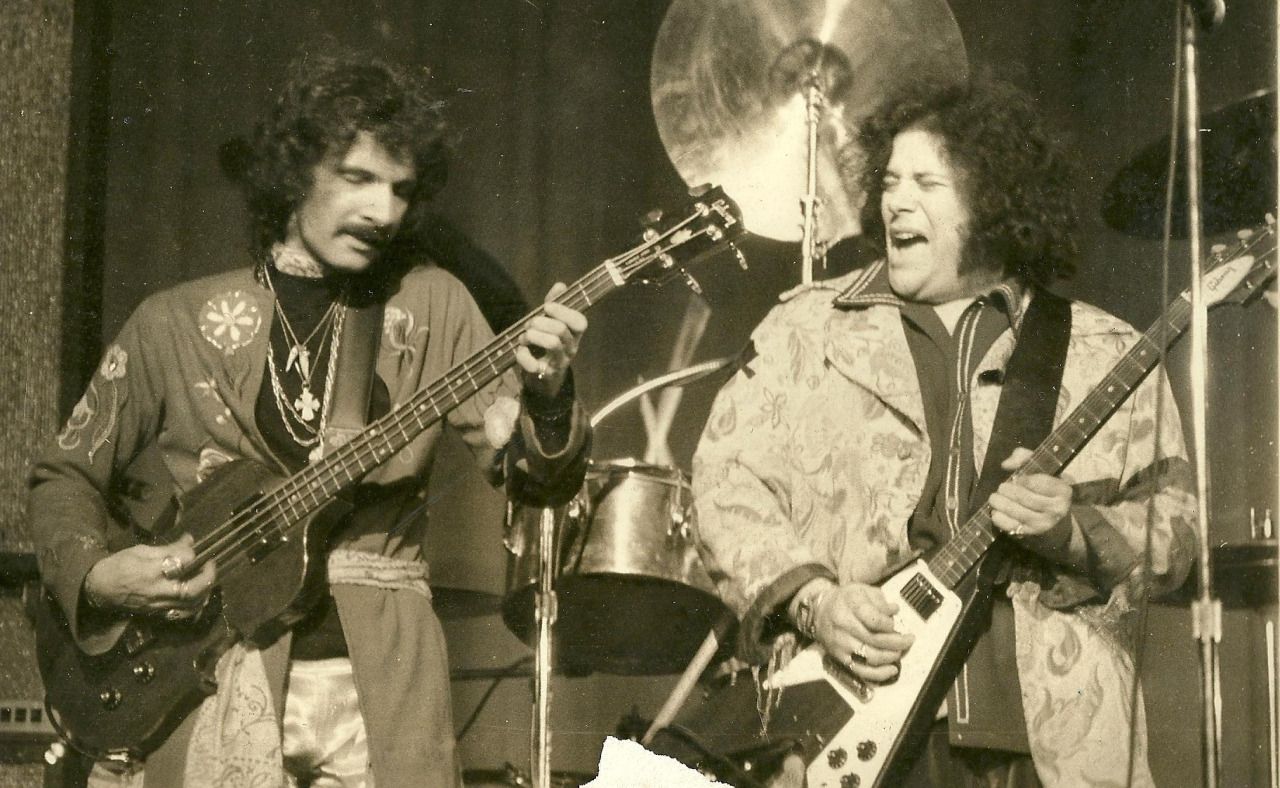
The guitars: Les Paul Jr [“a tree with a microphone” – he loved the P90 pickups], Gibson Flying V

The sound: Huge tone. It’s a big wall of sound.  He wanted his guitar to sound like three guitars.  West was a melodic player who didn’t play too fast. He once remarked that he didn’t know what “shredding” meant.  He was a proponent of the “less is more” approach.  Felix Pappalardi taught him “don’t play anything you can’t sing.”  Sometimes it’s difficult to describe someone’s music.  You kind of know what you want to say, but you’re not sure how to say it.  As is the case whenever a musician of renown passes, Warren Haynes writes an eloquent essay, and he always manages to put into words what the rest of us are thinking.  Perhaps that’s why he’s such a good songwriter.  A few days ago, he wrote this about Leslie West:

“Leslie’s style as a guitar player was not only powerful but unique as well. He had warm, rich tone and a beautiful, wide vibrato that sounded like a human voice. That combined with his note selection and spacious phrasing really gave him that vocal-like quality that I’ve always personally been drawn to (as I’ve mentioned many times). His ability to choose the right notes and not overplay was in an odd way like a rock version of BB King.

I know there are some young guitar players out there playing a million notes that may not have listened to Leslie West.  Do yourself a favor and check it out. You’ll be glad you did.”

I can’t top that, and I won’t even try.  I checked out Leslie West’s playing a long time ago.  Warren is right – I’m glad I did.  Below is a playlist I’ve had for a while.  I limited to the first seven years of his recorded output for the sake of brevity. It clocks in at just short of two hours.

Tony’s Leslie West playlist:

Blood of the Sun [Leslie West – Mountain (1969)]
Dreams of Milk & Honey [Leslie West – Mountain (1969)]
This Wheel's On Fire [Leslie West – Mountain (1969)]
Mississippi Queen [Mountain - Climbing! (1970)]
Theme for an Imaginary Western [Mountain - Climbing! (1970)]
Never In My Life [Mountain - Climbing! (1970)]
Silver Paper [Mountain - Climbing! (1970)]
Sittin' On a Rainbow [Mountain - Climbing! (1970)]
Don't Look Around [Mountain - Nantucket Sleighride (1971)]
Nantucket Sleighride (To Owen Coffin) [Mountain - Nantucket Sleighride (1971)]
You Can't Get Away! [Mountain - Nantucket Sleighride (1971)]
The Great Train Robbery [Mountain - Nantucket Sleighride (1971)]
Flowers of Evil [Mountain – Flowers of Evil (1971)]
Baby Don’t You Do It [The Who – Whos’ Next Deluxe (1995)]
Why Dontcha [West, Bruce & Laing – Why Dontcha (1972)]
Out Into The Fields [West, Bruce & Laing – Why Dontcha (1972)]
Shake Ma Thing (Rollin Jack) [West, Bruce & Laing – Why Dontcha (1972)]
Pollution Woman [West, Bruce & Laing – Why Dontcha (1972)]
Love Is Worth the Blues [West, Bruce & Laing – Why Dontcha (1972)]
Rock 'N' Roll Machine [West, Bruce & Laing - Whatever Turns You On (1973)]
Backfire [West, Bruce & Laing - Whatever Turns You On (1973)]
Token [West, Bruce & Laing - Whatever Turns You On (1973)]
Crossroader [Mountain – Twin Peaks (1974)]
Don't Burn Me [Leslie West – The Great Fatsby (1975)]
E.S.P. [Leslie West – The Great Fatsby (1975)]
Dear Prudence [Leslie West - The Leslie West Band (1976)]
Sea of Heartache [Leslie West - The Leslie West Band (1976)]


1/16/22
 
Not content with having a single Leslie West playlist, here’s another one I compiled from his work between 1988 and 2015.

Masters of War [Mountain - Masters of War, 2007]
Standing On a Higher Ground (feat. Billy F. Gibbons) [Unusual Suspects, 2011]
One More Drink for the Road (feat. Steve Lukather) [Unusual Suspects, 2011]
Busted, Disgusted or Dead (feat. Johnny Winter) [Still Climbing, 2013]
Third Degree (feat. Joe Bonamassa) [Unusual Suspects, 2011]
Serve Somebody [Mountain - Masters of War, 2007]
Subterranean Homesick Blues [Mountain - Masters of War, 2007]
Long Red [Still Climbing, 2013]
To the Moon [Unusual Suspects, 2011]              
A Stern Warning [Soundcheck, 2015]
Tales of Woe [Still Climbing, 2013]
Blues Before Sunrise [Blue Me, 2006]
I Woke Up This Morning [Blue Me, 2006]
Four Day Creep [Blue Me, 2006]
Crawlin' Kingsnake [Blues to Die For, 2003]
Louisiana Blues [Got Blooze. 2005]
(Look Over) Yonder's Wall [Got Blooze. 2005]
Spoonful [w/ Jack Bruce] [Theme, 1988]
I'm Ready [Blues to Die For, 2003]
Going Down [Soundcheck, 2015]
Walk in My Shadow [Got Blooze. 2005]
Hellhound on My Trail [Blues to Die For, 2003]
As Phat As It Gets [As Phat As It Gets, 1999]
Here For the Party [Soundcheck, 2015]
Empty Promises / Nothin' Sacred [Soundcheck, 2015]
Don't Start Me Talkin' [Blues to Die For, 2003]
Nothing's Changed [Unusual Suspects, 2011] 
Love You Forever [Unusual Suspects, 2011] 


Wednesday, August 26, 2020

Justin Townes Earle - A Playlist [RIP]

Justin Townes Earle died the other day. I was shocked, but not surprised, given his own history and that of his father.  Like his father, he was a very good songwriter. But he sang a lot better than his father.  I won’t do the deep dive on his work like I have on others.  Suffice to say, pick a song, any song, and you’ll like what you hear. “Bro Country” this is not.  This is what country music is supposed to sound like – no frills, no bullshit.  His work reminds me of that of Jason Isbell.  I found a great line about his songwriting – he “turpentined everything down to the essence”.  I can’t write it any better, so I’ll leave it like that.  Like his namesake Townes Van Zandt, he’s gone way too early.  Here’s a playlist I put together today:

Harlem River Blues (Harlem River Blues - 2010)

Lone Pine Hill (The Good Life - 2008)

Rogers Park (Harlem River Blues - 2010)

Yuma (Yuma - 2007)

Mama’s Eyes (Midnight at the Movies - 2009)

Memphis In The Rain (Nothing's Gonna Change the Way You Feel About Me Now - 2012)

Ahi Esta Mi Nina (The Saint of Lost Causes - 2019)

One More Night In Brooklyn (Harlem River Blues - 2010)

Kids In The Street (Kids in the Street - 2017)

Can’t Hardly Wait (Midnight at the Movies - 2009)

Nothing's Gonna Change The Way You Feel About Me Now (Nothing's Gonna Change the Way You Feel About Me Now - 2012)

If I Was The Devil (Kids in the Street - 2017)

White Gardenias (Single Mothers – 2014)

The Saint of Lost Causes (The Saint of Lost Causes - 2019)

Who Am I to Say (The Good Life - 2008)

Won’t Be the Last Time (Nothing's Gonna Change the Way You Feel About Me Now - 2012)

Someday I’ll Be Forgiven for This (Midnight at the Movies - 2009)

When the One You Love Loses Faith (Absent Fathers – 2015)

Champagne Corolla (Kids in the Street - 2017)

Frightened by the Sound (The Saint of Lost Causes - 2019)

Maybe A Moment (Kids in the Street - 2017)

Graceland (Single – 2017)

Appalachian Nightmare (The Saint of Lost Causes - 2019)

Midnight at the Movies (Midnight at the Movies - 2009)

Look the Other Way (Nothing's Gonna Change the Way You Feel About Me Now - 2012)

Christchurch Woman (Harlem River Blues – 2010)

Ain’t Waitin’ (Harlem River Blues - 2010)


Saturday, April 18, 2020

John Prine - RIP


Wildly imaginative, witty, humble, hilarious, wry, tender, offbeat, empathetic, insightful, spine-chilling, magnetizing, lighthearted, illuminating, overpowering, honest, simple, timeless, introspective, heartfelt, challenging, influential, underappreciated, under the radar, hard-to-categorize, straightforward, whimsical, fatalistic.

Since John Prine died the first week of April, I’ve been scouring the Internet to find adjectives written by people who write much better than I to describe John Prine’s music.  I found a lot of them.  I’m quite sure the list I’ve compiled is incomplete, but each one applies.  A friend of mine from the old neighborhood said “there’s no such thing as a bad John Prine song” – and she’s right.  If there is one, I haven’t heard it.

As is my wont, whenever a musician I like passes away, I do the deep dive into the songbook and try to create a good playlist.  Keeping in mind my friend’s thoughts about there being no bad John Prine songs, some are more equal than others.  Otherwise, my playlist would be every song John Prine ever recorded.  Not all the songs on my list were written by him.  There’s a Hank Williams song here, and A.P. Carter song there, and a Buck Owens song somewhere else, but I like how he played them.  The entire debut album is here because it was that good.  There is much to enjoy.

Here’s my playlist.  As always, it’s just one pinhead’s point of view [mine].

Illegal Smile [John Prine, 1971]
Spanish Pipedream [John Prine, 1971]
Hello In There [John Prine, 1971]
Sam Stone [John Prine, 1971]
Paradise [John Prine, 1971]
Pretty Good [John Prine, 1971]
Your Flag Decal Won't Get You Into Heaven Anymore [John Prine, 1971]
Far From Me [John Prine, 1971]
Angel From Montgomery [John Prine, 1971]
Quiet Man [John Prine, 1971]
Donald and Lydia [John Prine, 1971]
Six O'Clock News [John Prine, 1971]
Flashback Blues [John Prine, 1971]
The Late John Garfield Blues [Diamonds in the Rough, 1972]
Sour Grapes [Diamonds in the Rough, 1972]
Billy the Bum [Diamonds in the Rough, 1972]
The Frying Pan [Diamonds in the Rough, 1972]
Yes I Guess They Oughta Name a Drink After You [Diamonds in the Rough, 1972]
Sweet Revenge [Sweet Revenge, 1973]
Please Don't Bury Me [Sweet Revenge, 1973]
Christmas In Prison [Sweet Revenge, 1973]
Blue Umbrella [Sweet Revenge, 1973]
Mexican Home [Sweet Revenge, 1973]
Often Is a Word I Seldom Use [Sweet Revenge, 1973]
Linda Goes to Mars [German Afternoons, 1986]
Let's Talk Dirty in Hawaiian [German Afternoons, 1986]
Dear Abby (Live) [Sweet Revenge, 1973]
Other Side of Town (Live) [Fair & Square, 2005]
Quit Hollerin' at Me (Live) [Live on Tour, 1997]
Space Monkey (Live) [Live on Tour, 1997]
He Was In Heaven Before He Died [Common Sense, 1975]
The Accident (Things Could Be Worse) [Sweet Revenge, 1973]
Bruised Orange (Chain of Sorrow) [Bruised Orange, 1978]
That's the Way the World Goes Round [Bruised Orange, 1978]
Come Back to Us Barbara Lewis Hare Krishna Beauregard [Common Sense, 1975]
Jesus, the Missing Years [The Missing Years, 1991]
Lake Marie [Lost Dogs and Mixed Blessings, 1995]
Everything Is Cool [A John Prine Christmas, 1994]
The Sins of Memphisto [The Missing Years, 1991]
Great Rain [The Missing Years, 1991]
Ain't Hurtin' Nobody [Lost Dogs and Mixed Blessings, 1995]
In Spite of Ourselves [In Spite of Ourselves, 1999]
Mental Cruelty [For Better, or Worse, 2016]
Just Waitin' [For Better, or Worse, 2016]
Crazy as a Loon [Fair & Square, 2005]
Bear Creek Blues [Fair & Square, 2005]
Lonesome Friends of Science [The Tree of Forgiveness, 2018]
Summer's End [The Tree of Forgiveness, 2018]
When I Get to Heaven [The Tree of Forgiveness, 2018]

RIP John Prine, and thank you.


Saturday, December 30, 2017

In Memoriam...

At the end of last year, CNN labeled 2016 as “the year the music died”.  As is their wont, they got it wrong.  CNN’s “year that music died” began the last week of 2015, when cancer claimed Lemmy Kilmister on December 28th, 4 days after turning 70 and 17 days after his final show in Berlin.  No doubt that 2016 took its toll on the music.  Natural causes claimed all of these musicians except two [Keith Emerson and Prince].  Father Time began to take musicians in bunches from the time my favorite music was made [and these are just the ones I feel like mentioning]:

David Bowie - Jan. 10, 2016
Glenn Frey [The Eagles] - Jan. 18, 2016
Paul Kantner and Signe Anderson [Jefferson Airplane] - Jan. 28, 2016
Maurice White [Earth, Wind & Fire] - Feb. 4, 2016
Keith Emerson [Emerson, Lake & Palmer] - March 11, 2016
Merle Haggard - April 6, 2016
Prince - April 21, 2016
Guy Clark - May 17, 2016
Ralph Stanley - June 23, 2016
Bernie Worrell [Parliament-Funkadelic, Talking Heads] - June 24, 2016
Scotty Moore - June 28, 2016
Stanley "Buckwheat" Dural Jr - Sept. 24, 2016
Leonard Cohen - Nov. 7, 2016
Leon Russell - Nov. 13, 2016
Greg Lake [King Crimson, Emerson, Lake & Palmer] - Dec. 7, 2016
George Michael – Dec. 25, 2016

2016 was only the beginning.  More music “died” in 2017.  This year we said goodbye to two men who were there at the beginning of “rock & roll” – Chuck Berry and Fats Domino.  Natural causes claimed the “gentle giant” of country music, Don Williams.  Alzheimer’s claimed a legend, Glen Campbell.  Cancer took John Wetton, Grant Hart, Walter Becker, and Gregg Allman.  Depression reared its ugly head and prompted three musicians to take their own lives – Butch Trucks, Chris Cornell, and Chester Bennington.  A heart attack took Tom Petty from us, only one week after his final show at the Hollywood Bowl.  We didn’t see that one coming.  We’re still in a state of shock.  Wildflowers, Echo, Mojo, Hypnotic Eye and the two Mudcrutch albums have been in heavy rotation since that awful day.  Again, this list is not all-inclusive:

Butch Trucks [Allman Brothers Band] – Jan. 24, 2017
John Wetton – Jan. 31, 2017
Chuck Berry – March 18, 2017
J. Geils – Apr. 11, 2017
Col. Bruce Hampton [Ret.] - May 1, 2017
Chris Cornell – May 17, 2017
Gregg Allman – May 27, 2017
Chester Bennington – July 20, 2017
Glen Campbell – Aug. 8, 2017
Walter Becker – Sept. 3, 2017
Don Williams – Sept. 8, 2017
Troy Gentry – Sept. 8, 2017
Grant Hart [Hüsker Dü] – Sept. 13, 2017
Johnny Sandlin - Sept. 18, 2017
Tom Petty – Oct. 2, 2017
Gord Downie [Tragically Hip] – Oct. 8, 2017
Fats Domino – Oct. 25, 2017
Chuck Mosley [Faith No More] – Nov. 9, 2017
Malcolm Young – Nov. 18, 2017
Mel Tillis - Nov. 19, 2017
Pat DiNizio [The Smithereens] – Dec. 12, 2017

While I was caring for my wife as she was recovering from breast cancer, I discovered the industrial music of the German band Einstürzende Neubauten, and found Rammstein with all of their gratuitous pyrotechnic excess.  I reacquainted myself with the music of Alice Cooper, Steely Dan and the Smithereens.  My appreciation for the music of Jason Isbell [and his wife, Amanda Shires] grew by leaps and bounds.  My love for Tom Petty’s music was always there.

At the end of a calendar year, I look back and write a few words about the new music that I liked.  Usually I have a list.  This year I single out one album.  That album is Gregg Allman’s swan song, Southern Blood.  As Gregg Allman is my favorite singer, those who read these pages will not find this as a big surprise.  Released 3 ½ months after he died, Brother Gregg made his finest album in 44 years, and finally scored his first #1 [Billboard’s Americana Album chart].  What a shame he didn’t live to see it.

I wish that 2018 will see a smaller death toll among musicians that I enjoy, but seeing as how many are in their 60s and 70s I don’t see that happening.  Father Time is undefeated.